
From Waste to Wearable: #SankalpChangemakers features Revival Earth’s Fight to Redesign Global Textile Waste
How Yayra Agbofah is turning Ghana's biggest second-hand clothing market from a symbol of fashion's waste problem into a hub for circular design
By Edwin Methu and Punita Maheshwari
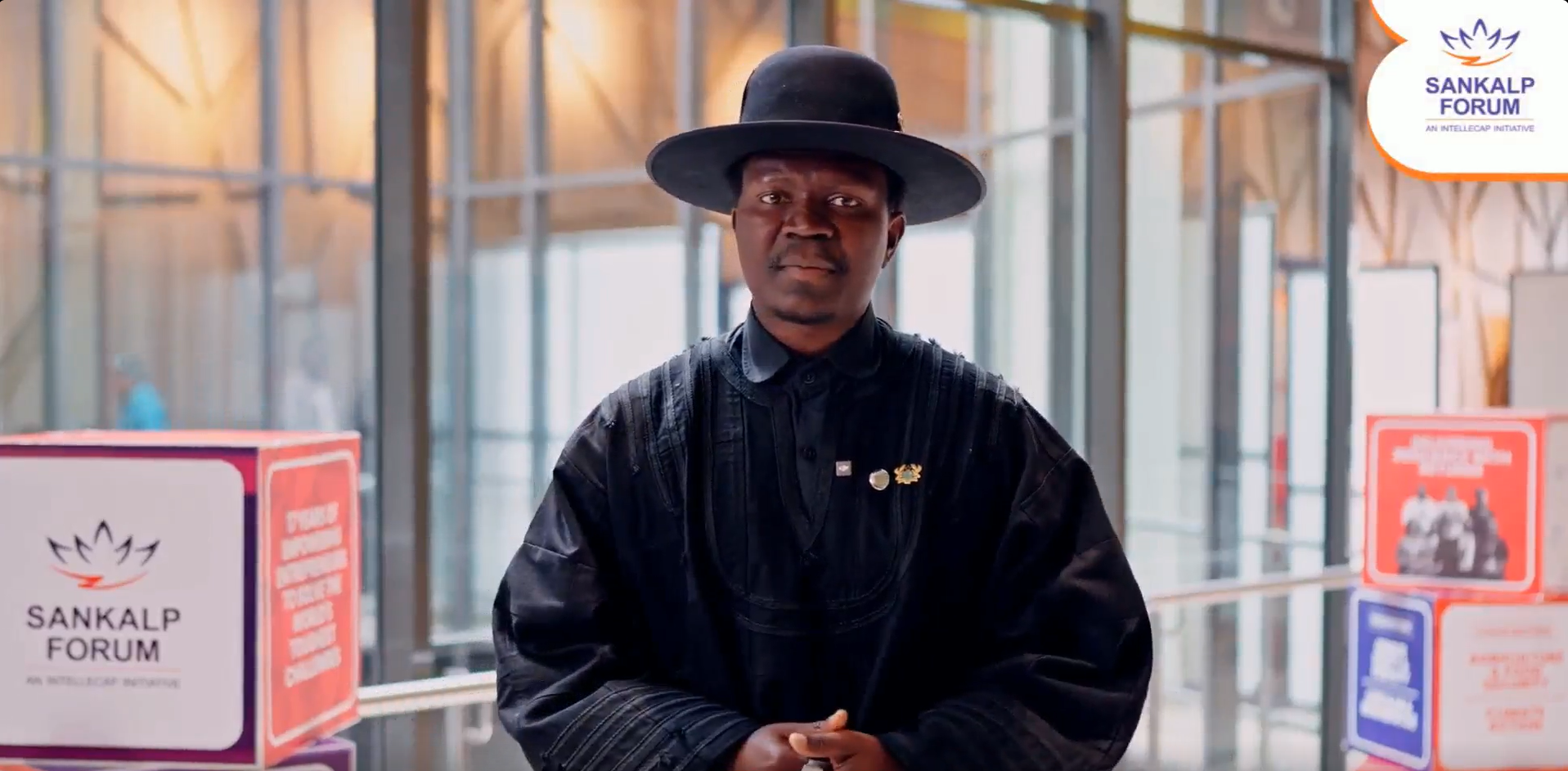
Kantamanto Market in Accra is one of the largest second-hand clothing markets in the world. It is also one of the clearest pictures of what fast fashion leaves behind: mountains of textile waste, moving through a community of traders, tailors, repairers, and head porters who absorb the cost of a global system they didn’t create. Yayra Agbofah grew up around this market, and it shaped the question that eventually became his life’s work: what if the waste piling up in Kantamanto wasn’t the end of the story, but the raw material for a new one?
That question led him to found The Revival Earth, an organisation that turns discarded textiles into upcycled fashion, art, and jobs, and that has since become one of the clearest examples of circular economy thinking built from within the community it serves, rather than imposed on it from outside.
Founding & journey
Agbofah traces the idea back to time spent with the people who keep Kantamanto running day to day. “The turning point came when I began spending more time with traders, waste pickers, tailors, and head porters (Kayayei) who were bearing the environmental and economic burden of this global system,” he says. “I realised that what many people viewed as waste was actually a resource.”
That reframing, from waste to resource, is the founding logic of The Revival. Kantamanto is usually described as the end point of fashion’s waste problem. Agbofah saw it differently: an ecosystem already full of skill and entrepreneurial instinct. “Tailors, traders, repairers, and artisans were already practicing circularity long before it became a global trend,” he says. “If the problem exists in our community, then the solution should also be built within our community.”
Innovation & creativity
Design at The Revival starts with the material, not the other way around. “We work with what already exists rather than imposing a design and searching for resources later,” Agbofah explains. Every product is judged against three criteria: environmental impact, aesthetic value, and market demand. “We are not interested in creating products that people buy out of sympathy. We want people to choose them because they are beautiful, well-made, and meaningful.”
That discipline gets harder at scale, since no two batches of waste textile are alike. Agbofah’s team has learned to build around categories of material rather than individual garments, identifying supply streams consistent enough to support repeatable product lines, while still leaving room for one-of-a-kind pieces. “The challenge is finding the balance between artistic expression and operational efficiency,” he says.
Business model & operations
Upcycling, education, job creation, and community empowerment aren’t separate programmes at The Revival. They are one loop. “When a young person learns design skills, transforms waste into a product, earns income, and eventually starts their own enterprise, all four elements are working together,” Agbofah says. The goal, as he puts it, is long-term community resilience rather than one-off interventions.
Running that loop inside Kantamanto comes with real operational strain. Reliable workspace, storage, energy, machinery, and access to finance all constrain how fast The Revival can grow. A fire that tore through Kantamanto in January 2025 made that fragility impossible to ignore. “The devastating fire in Kantamanto reinforced how vulnerable informal economies can be and highlighted the need for stronger community infrastructure,” Agbofah says. “Scaling in this environment requires constant adaptation, but it has also made us more innovative and resilient.”
Impact & community
Ask Agbofah what keeps him motivated, and he points to individual stories rather than aggregate numbers. He recalls a young woman who joined The Revival with no formal training but a strong willingness to learn, and who went on to build real skill in garment construction, quality control, and product development. She now earns a living through her craft and has become a role model in her community. “What inspires me most is not only the economic change but the confidence and sense of possibility she has gained,” Agbofah says. “These stories remind me that circular fashion is ultimately about people, not just products.”
Women and young people sit at the centre of that work. The Revival’s programmes, many of them built specifically for women traders, kayayei, and young creatives, offer skills training, mentorship, paid opportunities, and pathways into entrepreneurship. “Our goal is not simply to provide employment but to create leadership opportunities and economic independence,” Agbofah says.
Market & scale
The Revival operates as both a community organisation and a design innovation platform, and Agbofah is deliberate about what each role is meant to prove. Locally, the aim is to show that circular fashion can create jobs and strengthen a community. Internationally, the aim is bigger: to challenge the assumption that innovation flows only from the Global North. Through collaborations with museums, brands, universities, and cultural institutions, Agbofah wants Kantamanto seen for what it already is: not a passive recipient of the world’s fashion waste, but a place developing circular solutions of its own.
Asked what success looks like over the next three to five years, Agbofah resists measuring it purely in growth. “Success is not measured only by growth but by systems change,” he says. He wants to see millions more garments diverted from landfill, hundreds of young people and women trained, dozens of community-led enterprises launched, and stronger recycling infrastructure built in Ghana, alongside circular design education becoming more accessible and Kantamanto recognised globally as a hub of innovation rather than a symbol of waste.
Challenges & reality check
Pressed on the biggest obstacles ahead, Agbofah names three: limited recycling and processing infrastructure, a shortage of long-term patient capital for community-led innovation, and the continued flow of low-quality clothing into markets like Kantamanto. It’s the third one that worries him most. “If the fashion industry continues producing disposable clothing at scale, communities like ours will continue carrying the environmental and economic costs,” he says.
Vision & future
Agbofah’s long-term vision reaches beyond his own organisation. He wants Africa to stop being defined as the destination for the world’s fashion waste and start being recognised as a leader in circular fashion innovation. For The Revival, that means building a network of community-led circularity hubs, creating dignified jobs, investing in local recycling infrastructure, and training the next generation of designers and entrepreneurs.
“I hope we can help create a future where waste is designed out of the system, communities are fairly valued, and Africa is recognised not for the challenges it faces but for the solutions it is creating,” he says.
(Editor’s note: Yayra Agbofah received the Trailblazer recognition at the Sankalp Africa Summit 2026.)