Self-Made, Self-Funded: The “Heroines” of Middle India
62% of the women entrepreneurs in an RBIH–SALT study are self-funded. At Sankalp, funders, founders and researcher-authors talk about making finance work for women-led businesses.
By Punita Maheshwari
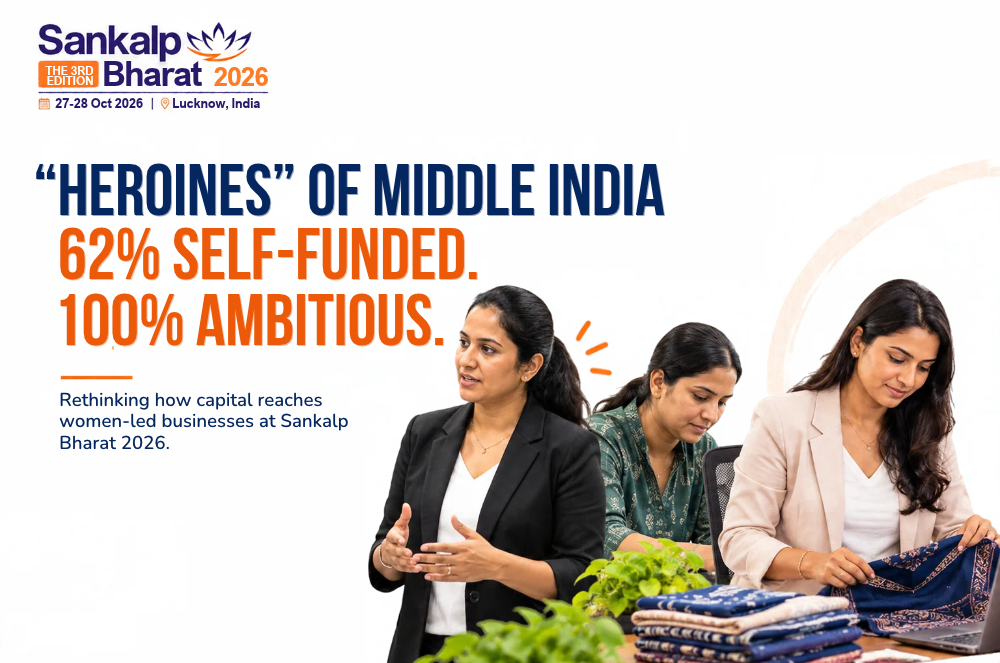
Heroines: That is the word the report At the Helm: Women Entrepreneurs Transforming Middle India chose for the women entrepreneurs it studied: 300 well-networked women running businesses across India’s Tier 2 and Tier 3 cities.
When the researchers dug into how these women got there, what came out was a lot of grit, power moves, sharp business thinking and a fair amount of household drama and stories!
Parveen Hafeez runs Sunrise Hospital in Kochi and a hospital software company, and still fields routine questions at home about the dinner menu. Jinkal Patel started as an “intern” at her father’s pharma company. She now runs business expansion between Baroda and Mumbai, and jokes about how differently she would have been received as a son. Priyanka Pattnaik‘s father-in-law offered her a business as an “afternoon engagement.” She turned Falcon Feeds into a profitable vertical of the family group in Bhubaneswar while raising two children.
A team from the Reserve Bank Innovation Hub (RBIH) and SALT-mysaltapp had to go and find them through the chapters of the FICCI Ladies Organisation (FLO), the women’s wing of the Federation of Indian Chambers of Commerce and Industry. They spent April to June 2023 on roads, trains and flights, and met women in their offices, factories, stores, farms and even their homes.
These are established small and medium businesses. More than half earn revenues of up to Rs 1 crore, and the women work across lifestyle, hospitality, manufacturing, healthcare, education, pharma and speciality chemicals.
90.2% call the shots in their roles. 55% hold a postgraduate degree or an MBA. Most are between 30 and 60, because success for women here tends to come later.
Tier 2 cities, global businesses
Indore and Jaipur led the study with 26 women each, followed by Vadodara at 25 and Ludhiana at 21. The report says the ecosystem built in Indore, Kochi, Coimbatore and Vadodara is now spreading to Bhubaneswar, Dehradun and Ludhiana.
Vadodara: Geeta Goradia’s Jewel Consumer Care ships toothbrushes and oral care products to leading global brands.
Ludhiana: Shingora Shawls, built by Mridula Jain, earns 90% of its business from exports.
Jaipur: Leela Bordia brought blue pottery back to life through Neerja Blue Pottery, with over 500 artisans across three generations. Coimbatore: Mohanasundari Jagannathan of Sharp Electrodes runs a unit operated entirely by women, along with an ITI that trains local youth in welding and plumbing.
The finance gap and question
This is where the capital gap difficult to ignore, only 3% of these women had accessed a bank loan or equity to start or grow their business. Across emerging and developing economies, women-owned MSMEs face a finance gap of about US$1.9 trillion. Silicon Valley, which prides itself on spotting what everyone else misses, keeps missing this too.
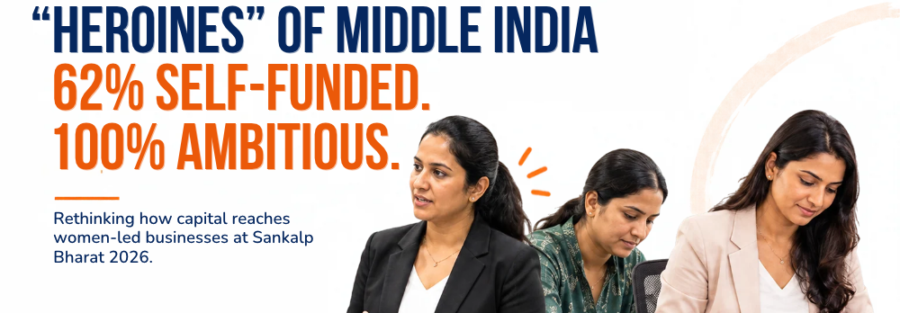
Grants do not seem to be a go-to choice either. Only 2% of the women had used a government policy or grant. So the women are funding themselves. 62% are self-funded, and another 14.9% leaned on friends and family. Kudos to the savings game, because the growth is coming from reinvesting profits.
And even then, women get back credit worth only 27% of what they deposit. Men get 52%. The 25-point gap is where solutions are needed.
Who is closing the gap
Neetu Jain tried to help with her husband’s business and did not particularly feel welcomes or useful, but a irony was served and a bounced cheque settled it. She went through the Goldman Sachs programme for women entrepreneurs at NSRCEL, IIM Bangalore, and credits the Indian Green Building Council for her industry connections. She went on to start Panache Greentech Solutions, which makes roof coatings that cut energy use.
Lenders say they can’t find women but FICCI FLO chapters found 300 of them for this study. Others are building the bridge from both ends. Set up in 1983 and representing 12000 women, it runs a Startup Cell for women setting up businesses and an MSME Assist Cell. For this study, its chapters were the map that led researchers to the women.
Indian Industries Association (IIA) Representing MSMEs, IIA is identifying women who head industrial units in Uttar Pradesh, with women’s cells running in Lucknow and Meerut. The head of its Women Entrepreneur Cell has said women miss business events because they are managing both their industries and their households. The cell’s answer is to bring the network to them, through virtual meets for women members, including one on how incubation centres can grow women’s entrepreneurship.IIA also runs a single-window information desk for MSMEs with SIDBI. In 2026, IIA was the industry partner for Uttar Pradesh’s Pink Rozgaar Mahakumbh, which brought industries and women job seekers onto one platform.
Beyond Capital Ventures The India team is entirely women, and it builds gender into how it judges companies through a 2X-aligned framework. The reason is simple: as businesses scale, they don’t always need more equity, they need partners who understand how they work.
Satin Growth Alternatives Limited Satin Creditcare’s AIF arm is women-led by design, with an all-women board and investment leadership team. Its first investment went to Indic Wisdom, a woman founder-led maker of wood-pressed oils, through a quasi-debt and equity approach that sits between a bank loan and a VC round.
Finance needs to adapt to how women build and That means accounting for care breaks and low asset ownership, recognising that “late” success is also success, and reworking credit models that penalise older entrepreneurs. The report wants more meaningful grants, and more incubators and VC funds focused on women. It also asks for tax relief on childcare and for women-owned businesses to carry forward losses from maternity breaks. New airports and stations in Tier 2 cities could showcase local women entrepreneurs as role models is a ask too.
At the Sankalp Bharat Summit 2026
The panel for Making Finance Work for Women-led Businesses brings these threads together. Shinjini Kumar, Ex-Banker and Writer, co-authored At the Helm. She is joined by Simran Sahni, Founder of Keeros and President of FICCI FLO Lucknow, and Anandi Agarwal, Partner at Krishna Metal Works and Chairperson of the Women’s Wing at the Indian Industries Association. Pooja Monga, Principal at Beyond Capital Ventures, and Shivika Sethi, Managing Partner at Satin AIF, complete the panel.
Sources:
- At the Helm: Women Entrepreneurs Transforming Middle India – https://rbihub.in
- World Bank, SME Finance – https://www.worldbank.org/en/
topic/smefinance - WLRN, PitchBook US All In: Female Founders in the VC Ecosystem – https://www.wlrn.org/business/
2026-03-09/female-funding- sets-record-nationally-but- theres-more-to-this-story - FICCI Ladies Organisation, About FLO – https://ficciflo.com/?p=1604
- FICCI Ladies Organisation, Annual Report – https://ficciflo.com/wp-
content/uploads/2026/01/FLO- ANNUAL-REPORT-FINAL.pdf - Business Standard, Trade body to nurture, promote women biz leaders in UP’s MSME sector – https://www.business-standard.
com/industry/news/trade-body- to-nurture-promote-women-biz- leaders-in-up-s-msme-sector- 124072300006_1.html - Indian Industries Association, IIA Profile – https://www.iiaonline.in/
Intro_introduction.aspx - SME Post, Indian Industries Association sets up development centre for MSMEs in Lucknow – https://smepost.com/news/
indian-industries-association- sets-up-development-centre- for-msmes-in-lucknow/8297 - ImpactAlpha, In India’s venture capital market, proximity pays – https://impactalpha.com/in-
indias-venture-capital-market- proximity-pays/ - Satin Creditcare, Women-Led AIF Fund press release – https://satincreditcare.com/
wp-content/uploads/2025/07/ SATINPRESSRELEASE-1.pdf - Anandi Agarwal, LinkedIn (Pink Rozgaar Mahakumbh 2026) – https://in.linkedin.com/in/
anandiagarwal09