Cards on the Table, Dots on the Map: The Public Rails Linking Identity and Livelihoods to the citizens
From EkStep's Blue Dot to Aadhaar's OVSE, there's a lot that makes it easier to share identity and find work. The Sankalp Bharat Summit 2026 brings the builders and founders into one room to explain how it all fits together.
ON ITS FIRST MAP QUEST
Like OVSE, the Blue Dot project has also run its pilots! Ghaziabad was one of the first two places where EkStep tested the idea. The other was Hubballi-Dharwad in Karnataka, where it began as a single government ITI and grew to 350 MSMEs with more than 1,100 fresh graduates joining the work force. Uttar Pradesh took the project further as Blue Dot launched statewide and opened its first Joint Facilitation Centre in Muzaffarnagar.
FOUNDERS AND CAPITAL MEET AT THE JUNCTION
The pilot programs were rehearsals well-done. However, the real show begins only when founders and capital make it a houseful. And Caret Capital has set itself a blockbuster target: 10 million jobs through the companies it backs.
In February 2026, Caret Capital backed Bharat10M, an accelerator launched with EkStep and is built on Blue Dot. The accelerator supports startups helping workers get from “looking for work” to “ready to work” with job discovery, digital identity, and voice tools in Indian languages they are comfortable with.
The initiatives in question are trying to make access to employment as inclusive as possible.
Let’s take Rashmi’s mom for example. She might not be familiar with technology or might not even own a phone of her own. How do we ensure that she and a million others like her have access to the job market?
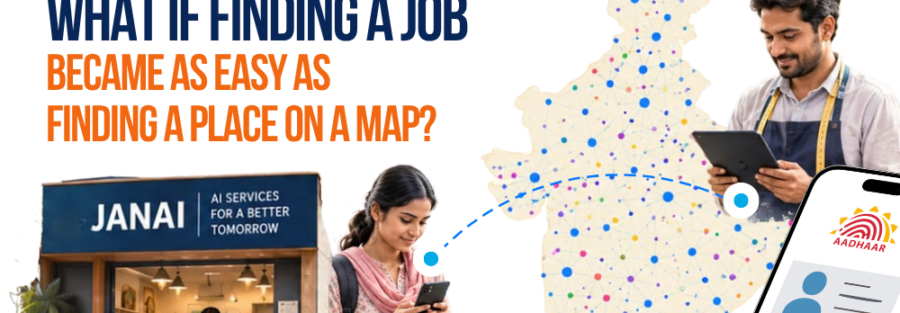
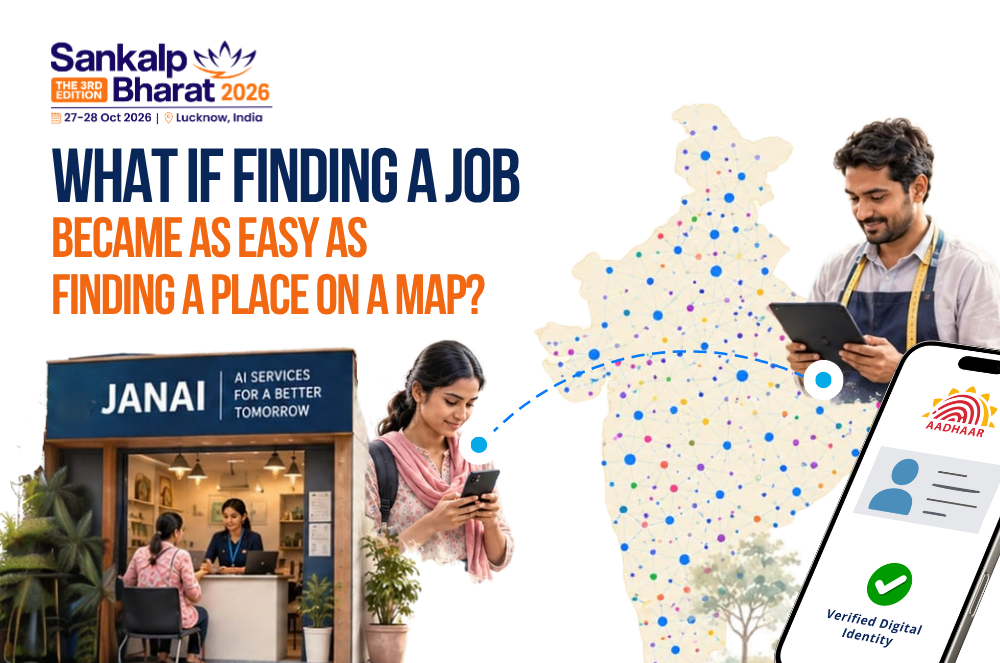
That’s exactly where JanAI comes in. It was founded by Madan Padaki through the Head Held High Foundation. They have 30 partners, including corporations, NGOs and governments who have come together to solve this problem specifically.
The company was founded in September 2026 and plans to reach 100 million households in the next three years through 10,000 JanAI cafes. So, what is a JanAI cafe?
It’s not your usual cafe. It’s a place where you can walk-in and order AI services to find information of govt schemes, jobs and financial services instead of a cappuccino or an espresso. You will find a trained local entrepreneur speaking your language!
JanAI already has nine cafes live, including one in Prayagraj. It aims to reach 100,000 citizens by March 2027. It runs on open-source Indian speech models and asks for consent before it touches anyone’s data.
The synergies are all in play at Sankalp Bharat 2026.
What's Next
The blue dots are only the beginning.
There are other colours too, providing more information at a glance. For example, there are purple dots for persons with disabilities and pink ones for women in the workforce. Blue Dot is set to introduce yellow and green too, denoting markers for education and farming. More colors will soon follow.
Meanwhile, Uttar Pradesh is joining the dots, and one division at a time. Led by the UP Skill Development Mission with support from EkStep Foundation and Head Held High Foundation, the rollout begins with a hub in Muzaffarnagar and will add a centre in every division, putting ITIs, employment exchanges and local MSMEs under one roof.
JanAI is brewing big plans for its cafes. Over the next three years, it wants one in every taluk, each run as a local enterprise owned by the village it serves. Caret Capital, via Bharat10M, will keep backing startups that build on these rails, all the way to 10 million jobs.
“Identity, Jobs and the Infrastructure Behind Bharat’s Next Leap” puts these builders in one room to talk about what’s working, what’s coming and what it could all add up to.
We welcome you to Sankalp Bharat 2026 to learn about the next chapter from the pioneers of this digital and employment
Sources:
UNI on the statewide launch from Muzaffarnagar: https://www.uniindia.com/yogi-
EkStep’s Blue Dot site: https://bluedotseconomy.org
Outlook Money on nearly 100 registrations: https://www.outlookmoney.com/
YourStory on Beckn powering Namma Yatri and ONEST, and his EkStep CTO role: https://yourstory.com/2024/07/
Caret Capital’s mission: https://www.caretcapital.in/
YourStory launch coverage: https://yourstory.com/2026/09/