By Punita Maheshwari
Energy poverty in rural India has long been framed as a technology problem, or a capital problem. Amit Saraogi, CEO and Co-founder of Oorja Development Solutions, came to see it as something else entirely: a mismatch between how solar was sold and how a farmer actually pays. Diesel worked because it was small, cash, and as-needed. Solar asked for the whole asset, upfront.
Nine years on, that reframe has grown into a company serving thousands of farmers across Uttar Pradesh and Bihar — backed by an independent study putting its verified social return at ₹4.35 for every rupee invested, a Seeding the Future Grand Prize win against 1,200 teams from 93 countries, and a 2X Best-in-Class Certification for gender-smart design. We spoke with Amit for the Sankalp Changemakers series about what nearly broke the model, what the sector still measures badly, and what it will take to reach a million farmers by 2030.
You built your career across business consulting, financial services, and international development before co-founding Oorja. What was the moment you realised markets alone weren’t solving energy poverty — and that you had to build the solution yourself?
It wasn’t one single moment, it was an accumulation. I’d spent years on the development side, doing primary research with UNICEF, working on poverty reduction strategy, sitting through the donor-funded project cycle, and I kept seeing the same pattern: good diagnosis, well-intentioned pilots, and then nothing that survived past the grant period. On the markets side, in finance and consulting, I saw the opposite problem: capital that was disciplined about returns but simply wouldn’t go near a smallholder farmer with two acres of land and no collateral.
The realisation was that energy poverty in rural India wasn’t a technology gap or a capital gap in isolation: it was a business model gap. Diesel pumps worked because they matched how a poor farmer actually transacts: small, frequent, cash-based payments, no upfront commitment. Solar, for all its advantages, was being sold the way you’d sell to a homeowner: own the asset, pay upfront. Nobody was redesigning the commercial model around how the farmer actually lives and earns. That’s the gap
Oorja was co-founded during a Climate-KIC program in Europe, but the problem you were solving was deeply rooted in rural India. How did that distance shape the way you designed the model?
The distance was actually useful, in a backhanded way. We couldn’t assume anything, so the very first thing we did after the programme was spend a month in the field doing a site selection survey and needs assessment before writing a single line of a business plan. Climate-KIC gave us frameworks and access to a network, and the discipline of having to defend the idea to people who had zero context on rural Uttar Pradesh, which is a good stress test.
But the model itself was built, unbuilt, and rebuilt entirely on Indian ground. We actually started with residential mini-grids, which is what the European programme had us pitch. Once we were in the field and the state grid kept expanding into the villages we were targeting, that model simply didn’t have a future. We pivoted to irrigation because that’s where the unmet need clearly was. If we’d designed in a vacuum in Europe and just executed that plan in India, we would have built the wrong company. The European framework acted as a useful toolkit to kick start a venture that was truly grounded in the reality of rural Uttar Pradesh.
Pay-per-use is elegant in theory but operationally brutal — cash flows are thin, farmer trust takes time, and last-mile logistics are punishing. What nearly broke the model in the early years, and what held it together?
One of the real challenges in the early years was the mismatch between capital-intensive infrastructure (we own and finance every pump) and revenue that comes in tiny increments, tied to monsoon patterns, crop cycles, and a farmer’s day-to-day cash position. There were stretches where we had assets in the ground already generating real value for farmers, but the receivables cycle and our own balance sheet were still under strain working through it. Trust was the other piece: you cannot rush a smallholder into changing how he irrigates his field; that decision touches his entire season’s income, so the payoff on that trust-building takes time to show up in the numbers. Agriculture as a sector overall requires a huge amount of patience, and the timelines are fundamentally different. The business model and long term projections need to reflect that.
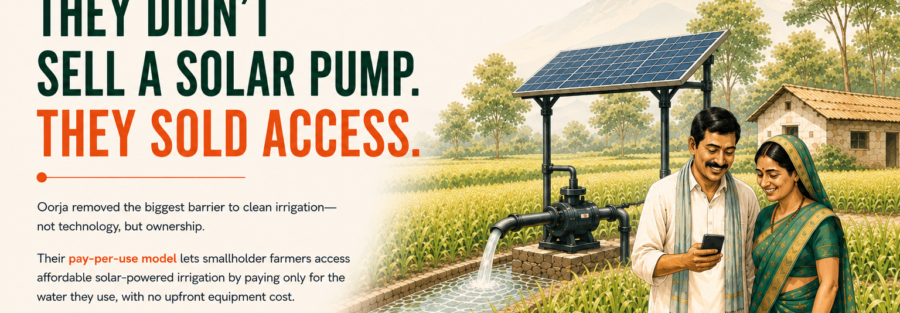
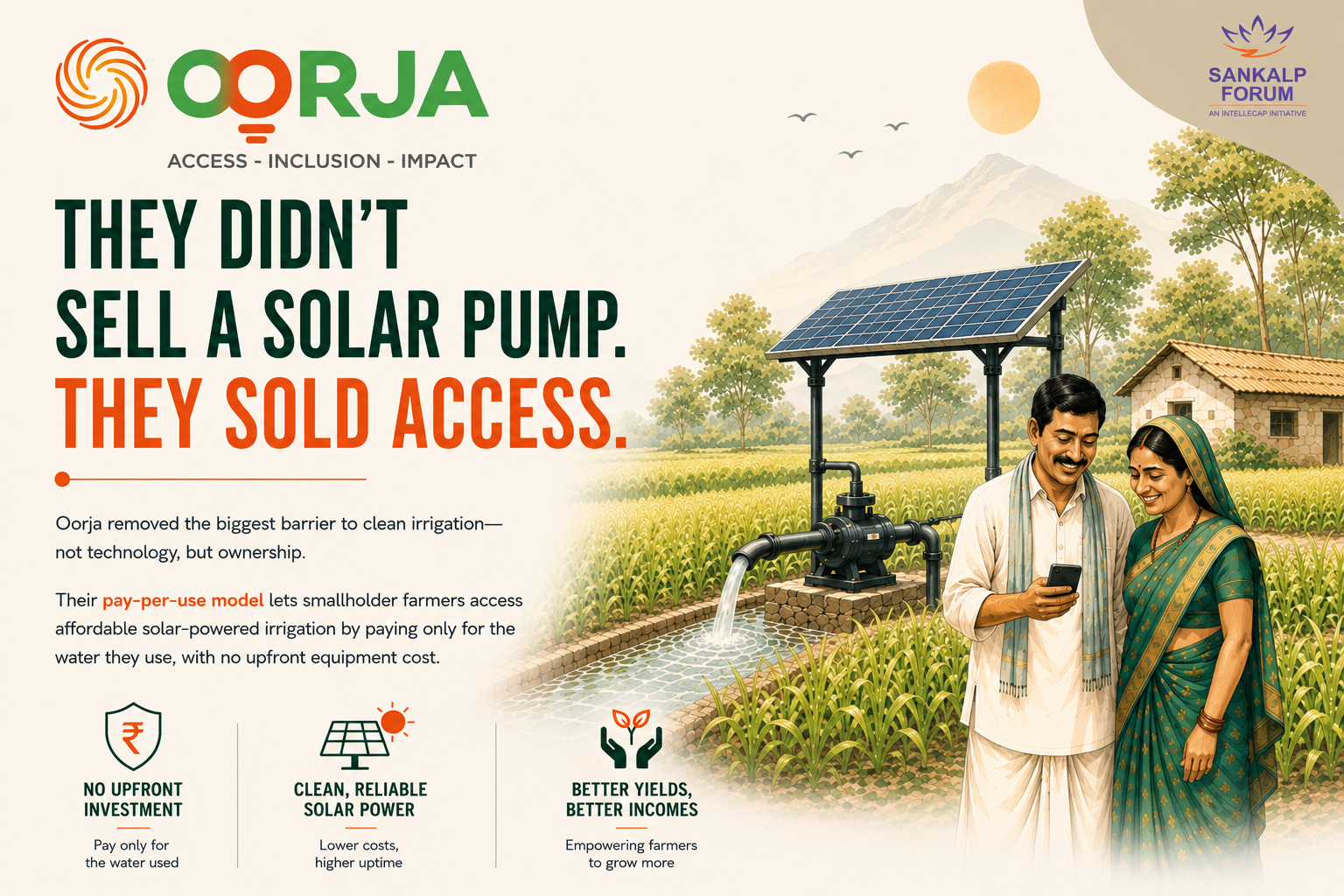
What held it together was refusing to ask farmers to change their behaviour more than necessary. We matched the payment frequency to what they already paid for diesel, and provided a huge discount on the cost per unit (our solution is 30-50% cheaper than the diesel alternative) so switching didn’t feel like a leap of faith for individuals who are inherently cash constrained. We also hired local farmers as pump operators rather than outside technicians, which did double duty: it solved last-mile servicing and it meant the person collecting payment and fixing problems was someone the community already trusted. Early grant and prize capital (things like the Keeling Curve Prize or the Echoing Green Climate Fellowship among others) enabled validation at moments when the volume of pumps and customers wasn’t there yet.
You sit at the intersection of clean energy and sustainable agriculture — two complex sectors. Was that always intentional, or did the bundling of irrigation, advisory, and soil testing evolve from what farmers actually needed?
It evolved, and I’d be overselling our foresight if I said we planned the whole stack from day one. We started as an energy company solving an energy problem: water lifted by solar instead of diesel. But once you’re standing in a farmer’s field for years, you can’t pretend irrigation is the only constraint on his income. Soil health, crop choice, input use, water-use efficiency: all of it is interconnected, and farmers were asking us about it because we were already the trusted, recurring presence on their land.
So the advisory layer, soil testing, and now things like vermicompost adoption got bundled in because farmers needed them, not because we set out to build an agri-tech company. The honest version is: we became a Farming-as-a-Service company because the energy problem, solved properly, kept pulling us deeper into agriculture. That’s also why we ended up being recognised by a food-systems body rather than purely an energy one; in other words, a social enterprise solving real agricultural problems and using energy access as an enabler.
85% of farmers can’t afford upfront solar investment. How do you make the unit economics work on pay-per-use without subsidising the model indefinitely?
A few levers, used together. First, we retain ownership of the asset and serve a cluster of farmers from a single solar pump rather than selling one pump per household: that single shift in asset utilisation is what makes the economics workable because you spread a capital-intensive asset across enough volume that per-farmer servicing costs come down. Second, our tariffs are deliberately benchmarked below what farmers were already paying for diesel, which keeps adoption easy without requiring us to operate at a loss; farmers save on their irrigation bill and we still recover cost plus margin over the life of the asset.
Third, we’re disciplined about blended finance rather than pure subsidy: grant and concessional capital have been funding the early de-risking of the model: deploying the first decentralised assets, testing new geographies, piloting interventions to encourage and incentivise behaviour
Third, we’re disciplined about blended finance rather than pure subsidy: grant and concessional capital have been funding the early de-risking of the model: deploying the first decentralised assets, testing new geographies, piloting interventions to encourage and incentivise behaviour
Oorja has been operating for nearly a decade. What’s the impact number you’re most proud of — and what’s the one you think the sector still isn’t measuring correctly?
The number I keep coming back to is the one from our 4th Wheel Social Impact SROI study: for every rupee invested in Oorja, we generated INR 4.35 in verified social value, a 1:4.35 ratio. That covers things like increased farmer income from crop diversification, reduced irrigation and input costs, improved food security, time saved and drudgery reduced for women, and lower diesel and chemical use. It’s a genuine testament to the cost-effectiveness of the model, and importantly, it’s not a number we get to frame ourselves. It was independently calculated, with standard discounting applied for deadweight, attribution, drop-off, and displacement.
What makes it more interesting than the headline ratio to me is the details behind the number: the value composition shifts by district depending on how long we’ve been present. In Bahraich, where we’ve operated four to five years, most of the value now comes from income growth through crop diversification. In newer districts like Barabanki and Hardoi, the value is still concentrated in short-term cost savings from switching off diesel. That tells us that the deeper, more structural livelihood gains take three to five years of sustained engagement to show up, not one season.
Most clean-energy and agri-
Winning the Seeding the Future Grand Prize meant competing against nearly 1,200 teams from 93 countries. What do you think set Oorja apart — and what does that kind of global recognition mean for how you access capital or partnerships in India?
I think what set us apart is that we weren’t pitching a single clever piece of technology but rather a proven, bundled service model with years of field data and independent verification behind it. Judges weren’t being asked to take a bet on a lab result; they were looking at a company that had already de-risked the “does this actually work for the farmer” question, and was asking a more interesting question: how do you bundle pay-per-use irrigation with advisory services in a way that compounds impact.
In terms of what it does for us: global recognition like this changes the nature of conversations with investors and partners. It doesn’t replace the hard work of proving unit economics, but it does shorten the distance to that conversation. When a global, independently judged process has already validated your model against nearly 1,200 peers, domestic investors and government partners take the diligence load more seriously, and conversations move faster from “convince me this is real” to “let’s talk about scale.”
Oorja received the 2X Best-in-Class Certification for gender-smart practices. In a male-dominated agricultural sector, what does genuinely embedding a gender lens look like on the ground — not just in hiring, but in how farmers interact with the service?
It starts with recognising that land titles in rural India are overwhelmingly held by men, even though women do an enormous share of the actual agricultural labour. In the geographical zones we work in, if you design a service that only signs up landholders, you’ve
We’ve also pushed this into our own team composition and into the field: training operators to engage women as decision-makers, not just as household members standing nearby while a man transacts. We track this with real targets rather than good intentions: women currently make up roughly a fifth of our direct irrigation customers, and we’re working to get that closer to a third by the end of the decade. None of it is dramatic, it’s a series of deliberate, unglamorous design choices that, added up, change who actually holds power and income within the household.
You’ve said your goal is to empower 1 million farmers globally by 2030. What needs to be true in the next 24 months for that to be on track?
Three things, mainly. First, we need to prove the model travels: not just across districts in Uttar Pradesh and Bihar, but into new states and eventually new geographies, without losing the unit economics that make it work. Second, we need the capital stack to mature: less reliance on grants and prize money for core operations, more structured blended and growth-stage capital that can fund asset rollout at real scale. Third, we need our digital and data infrastructure (metering, monitoring, farmer-facing apps and field-level apps) to be robust enough that we can run a much larger farmer base without proportionally larger headcount, effectively improving even further our unit economics by focusing on reducing manual labour, and using technology as a lever to improve net profitability per pump.
If those three things are true in two years, the trajectory to a million is a really question of capital and execution speed.
What would you say to a younger social entrepreneur who wants to work at the intersection of climate and livelihoods but is told the impact sector doesn’t pay or scale?
I’d say the “doesn’t pay or scale” line is usually a comment on a particular kind of impact work (i.e. grant-dependent, project-based, donor-cycle work) rather than on the sector as a whole. If you build something that genuinely removes a cost barrier for the people you’re serving, and you’re disciplined about unit economics from day one rather than treating them as an afterthought, you can build something that scales and that investors (not just donors) want to back. It took us years to get there, and we’re still working on it, but the proof points exist now: blended capital, gender-smart certifications, global recognition, real investor interest.
The other thing I’d say is: go and spend real time in the field before you design anything. Most bad “impact” ideas come from people who diagnosed a problem from a conference room. The model only became real for us once we’d spent weeks in Uttar Pradesh villages, not weeks in a workshop in Europe. Be patient with trust-building, be ruthless about the economics, and don’t let anyone tell you those two things are in conflict.
Editorial Note:
#SankalpChangemakers features Amit Saraogi, Co-founder of Oorja Development Solutions, on nine years of building pay-per-use solar irrigation for smallholder farmers.
This interview was conducted as part of the Sankalp Changemakers series, which profiles founders building enterprises at the intersection of climate, livelihoods, and inclusion across the Global South.
Oorjaa was one of the nominees at Sankalp Bharat Awards 2025. With thanks to Audrey Fillon, Oorja’s Chief Business Officer, for co-drafting these responses alongside Amit.