
By Margaret Nakunza
Across East Africa, roughly 95% of households still depend on solid fuels like wood and charcoal for cooking, and outside Kenya, fewer than 10% have access to cleaner alternatives like LPG or electricity. That dependence exposes an estimated 390 million people to indoor smoke and contributed to close to 294,000 deaths in 2021 alone, making household air pollution the region’s second leading cause of death. In Uganda specifically, roughly 96% of households depend on biomass fuel for cooking, a reliance responsible for an estimated 2.93% of all deaths nationwide. The same demand is straining the country’s forests: Uganda has lost more than 1.1 million hectares of tree cover, about 15% of its total, since 2001, with charcoal and firewood production among the leading drivers. By EzyLife’s own market estimates, more than 8 million Ugandan households nationally still rely on inefficient cooking methods; the company’s current push is concentrated on the roughly 1.5 million households in Eastern Uganda, alongside more than 20,000 schools, hospitals, and other institutions with heavy cooking energy needs.
For Lister Byamugisha, who founded EzyLife Holdings in 2018 and leads it today as CEO, the technology to fix this had existed for years. What was missing was never innovation. It was reach.
From an Accountant’s Desk to the Front Lines of Clean Cooking
Byamugisha didn’t set out to build a climate company. He joined EzyLife with a background in finance and accounting, brought on as the company’s accountant. It was a series of field visits — sitting with customers, hearing what a cookstove actually meant to a household — that changed the trajectory of his career.
“Listening to real stories on how the cookstove was actually helping the customers save real money by over 50%, the happiness with which customers used and talked about the stove, and the numerous referrals from satisfied customers sparked a desire to dive more into clean cooking,” he recalls. Women customers, in particular, kept repeating the same testimonies: time saved, food that stayed warm for hours, a home that felt easier to run. “It was a product that brought genuine happiness and ease into a home.”
That conviction carried him into senior management, where his focus shifted from the books to strategy — building more of those success stories and reaching deeper into the communities EzyLife served. It also opened the door to new partnerships with organizations advancing similar clean-cooking technologies, reinforcing a belief that has since become the company’s operating principle: the direct, immediate benefit to a family is what makes clean cooking spread on its own.
Headquartered in Mbale, Uganda, EzyLife now distributes and finances a portfolio of energy-efficient cooking products of its own design, including the Ecoa Char and Ecoa Plus cookstoves, electric pressure cookers, large-capacity institutional stoves for schools and hospitals, and fuel briquettes made from agricultural waste. By its own specifications, EzyLife’s
“The challenge was not innovation but rather access and affordability,” Byamugisha explains. “Efficient cookstoves have been existing, but what was missing was a scalable last-mile distribution model coupled with consumer financing for these life-changing stoves.”
Profit With Purpose
EzyLife’s tagline, “Profit with Purpose,” is less a slogan than an operating constraint. Every product the company deploys has to clear two bars at once: it must generate healthy margins, and it must visibly improve the lives of the people who buy it. “For every cooking technology deployed by EzyLife, we must create value for the customer through increased household savings, income creation, improved quality of life, and overall environment conservation,” Byamugisha says.
A Business-in-a-Box for Local Entrepreneurs
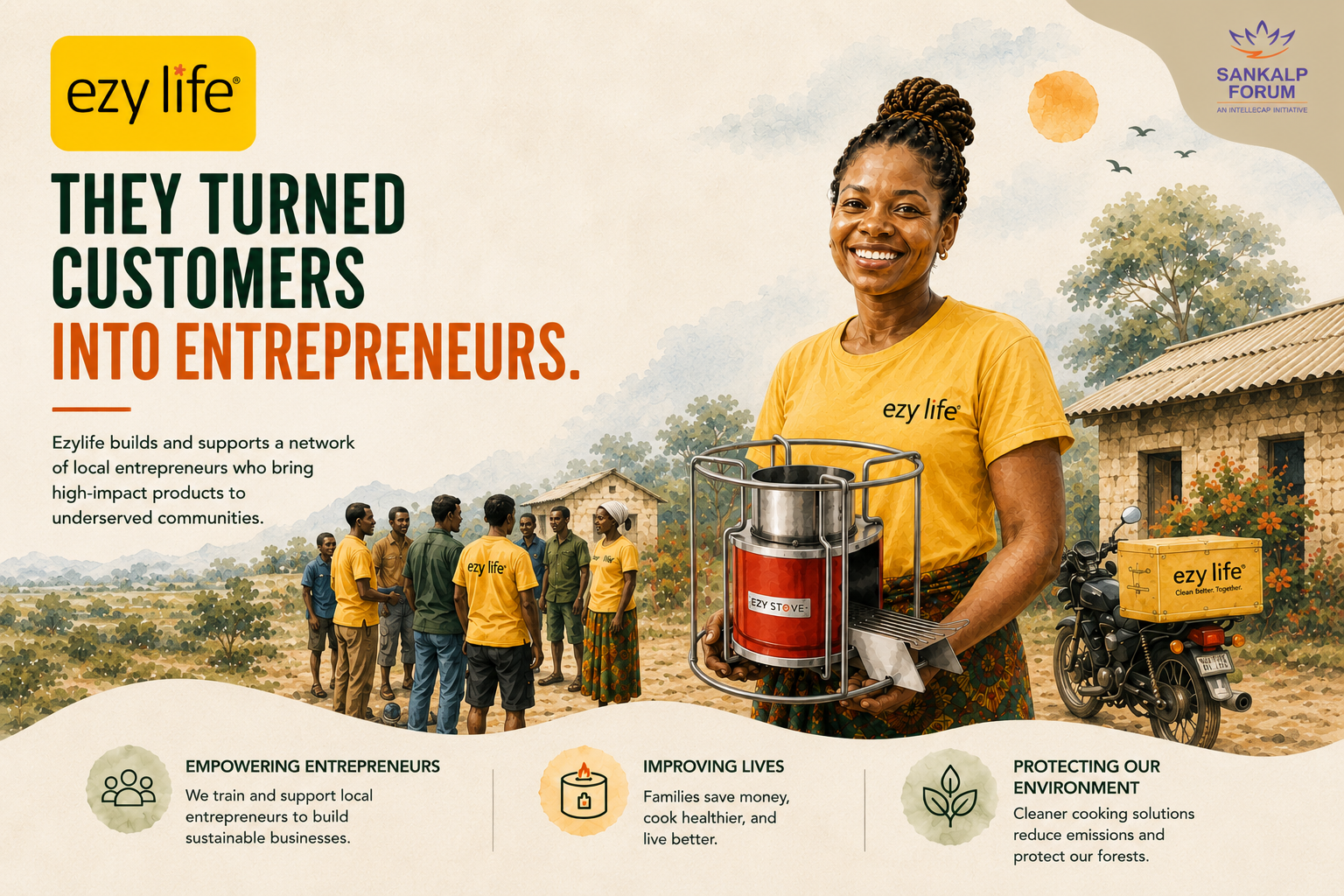
Rather than build its own retail footprint village by village, EzyLife built a franchise engine. The company identifies high-impact cooking technologies, recruits local entrepreneurs, and hands them a complete package: product training, sales and marketing support, after-sales service, and the products themselves, delivered to their doorstep.
That engine now runs on a distribution network of 18 direct sales agents, 20 distributors, and 10 community mobilizers on the ground across Eastern Uganda, supported by 5 online market channels reaching customers in both Eastern Uganda and Kampala. Through this network, EzyLife has engaged more than 2,000 Village Savings and Loan Associations (VSLAs) — the informal savings groups that anchor financial life in rural Uganda — and reached an estimated 276,000 people to date.
Freed from the burden of sourcing and logistics, entrepreneurs can focus entirely on customers, and over time grow into exclusive territory charters running their own distribution networks. Product selection follows the same purpose-first discipline: EzyLife assesses each item on the economic, social, and environmental benefit it delivers — reduced emissions, money saved, time recovered. In Byamugisha’s view, those measurable outcomes are what create durable demand rather than a one-time sale.
Proof in the Numbers
EzyLife’s numbers today are no longer projections. More than 70,000 cookstoves have been sold and distributed to date, reaching an estimated 276,000 people across Eastern Uganda through a network of more than 2,000 engaged Village Savings and Loan Associations. Current annual revenue stands at $200,000, and the underlying unit economics tell a story of steady improvement: EzyLife’s EBITDA margin was negative 82% in FY2021, the earliest year covered in its financial disclosures, and had climbed to roughly 20–22% by FY2024 and FY2025.
On the household side, EzyLife’s own expenditure surveys point to a roughly 63% reduction in monthly cooking energy costs for the average family, alongside about 2.5 hours saved daily that would otherwise go to cooking and fuel collection.
The PersistentClimate
Much of that scale has been financed through carbon markets. Under EzyLife’s collaboration with PersistentClimate India — lead proponent, carbon developer, and part-financier of the arrangement — EzyLife acts as the implementing partner, distributing over 65,000 cookstoves across two registered and verified carbon projects: 50,000 stoves under the Verified Carbon Standard (VCS 3045) and 15,000 stoves under the Gold Standard (GS 23170). The two projects continue to distribute improved biomass stoves today, and the partnership has also built out a local supply chain, including a manufacturing relationship with Masupa Stoves.
Using IPCC methodology for biomass fuel replacement, EzyLife
From Laughingstock to Community Mobilizer: Olivia’s Story
The clearest evidence of the franchise model’s power lives in individual stories, and Byamugisha points to Olivia, one of EzyLife’s earliest customers in Bulambuli. Olivia first encountered an improved cookstove through her village savings group, the Pambileko Savings & Loan Cooperative Group, where she served as chairperson. It was Kawacom, an organization supporting local coffee farmers, that invited EzyLife to
When Olivia bought her stove, neighbors mocked what looked like an extravagant purchase. The mockery didn’t last. As her savings group watched her cook faster and more cheaply than everyone else, curiosity turned into demand, and Olivia’s own mobilization skills did the rest: she referred five more savings groups in her village to the stoves.
EzyLife recruited her as a village mobilizer in 2020, an extension of its sales agents focused on sourcing new VSLAs. After driving 200 sales referrals through her networks, Olivia was offered a direct distributor contract covering her subcounty in Bulambuli. She has since facilitated the distribution of 850 cookstoves and remains one of EzyLife’s community ambassadors, stocking cookstoves and solar lanterns and expanding into other consumer goods her community needs. What began as agricultural income alone is now a diversified small business.
Women anchor much of this network. As the household managers in most of the communities EzyLife serves, and the largest constituency in local village savings groups, women make up a significant share of its distributor base. EzyLife incentivizes them to build their own distribution networks through community-based sales commissions, paired with training in business management — a direct route to financial independence.
Earning Trust in a Market That’s Seen Too Many Promises
Business-opportunity models have a mixed track record in Africa, and EzyLife’s answer to that skepticism is consistency: quality products, real product demonstrations, disciplined customer follow-up, and impact that can be measured rather than merely claimed. “Reaching underserved communities requires more than moving products,” Byamugisha says. “It requires building trust, training agents, creating local support systems, and maintaining product availability. Scaling impact requires patience and strong partnerships.”
That patience extends to how EzyLife balances consistency with flexibility. The company’s core principles — impact-driven products and real customer service — hold steady across every market it enters. Everything else, from product mix to financing structures to how agents engage customers, is left flexible enough for local teams to adapt to realities on the ground.
External Validation
EzyLife’s model has drawn backing from a notably well-documented list of institutions for a last-mile distribution business in rural Uganda:
- The Uganda Green Enterprise Finance Accelerator (UGEFA)
- Two registered and verified carbon credit projects, certified under the Verified Carbon Standard (VCS 3045) and the Gold Standard (GS 23170), developed in partnership with PersistentClimate India
- The Energy Enterprise Coach (EEC) HTCC program, delivered by NIRAS
- The GIZ/Equity Bank Building Markets initiative, which highlighted how Ugandan business consortia scaled together
- Recognition as an Energy Service Provider with the Uganda Energy Credit Capitalisation Company (UECCC)
- A technology partnership with Angaza, whose platform EzyLife used to increase cookstove sales by 190%
The Next Five Years
EzyLife’s ambitions for the next stretch are concrete: expanding its product catalogue into electric cooking, deepening its footprint across East Africa, and pushing further digitization and automation into its operations. In the nearer term, the company is targeting 250,000 or more households by 2030 and coverage across Uganda’s central region by 2028, alongside the launch of a formal carbon credit program by 2027. Byamugisha’s longer horizon is bigger still: reach at least 2 million people by 2032, generate $1.5 million in annual revenue, create more than 300 jobs, and cut 5 million tonnes of CO2 emissions.
Funding that growth has come with its own lessons. “One of the most important lessons is not to entirely source or rely on funding from grants, but to build self-sustaining businesses,” Byamugisha says. “While grants are great for catalyzing innovation, long-term growth and scaling requires building systems and a business capable of attracting investment from other forms of capital.”
The vision beyond that is bigger than any single product line. EzyLife wants to become the leading distributor of impact-driven products in Uganda and East Africa, empowering 1,000 businesses to solve real community challenges through the products it sources, and ultimately building a platform that connects impactful products, local agents, and investment capital to drive lasting transformation in underserved communities.
Editor’s Note
#SankalpChangemakers features Lister Byamugisha, Founder & CEO of EzyLife Holdings, whose clean-cookstove franchise is turning last-mile distribution into livelihoods across Eastern Uganda — reaching families the grid never did.
EzyLife Holdings and founder Lister Byamugisha were selected as one of six founders to pitch at ASCEND Africa 2026 at Sankalp Africa, recognised for building a last-mile distribution and financing model that is turning clean energy access into local livelihoods across East Africa.
Lister Byamugisha is Founder and CEO of EzyLife Holdings Limited, headquartered in Mbale, Uganda. EzyLife distributes and finances clean cookstoves, electric pressure cookers, institutional cooking equipment, and fuel briquettes through a franchise network of local entrepreneurs across Eastern Uganda, and has registered two carbon credit projects with PersistentClimate India under the Verified Carbon Standard and Gold Standard.