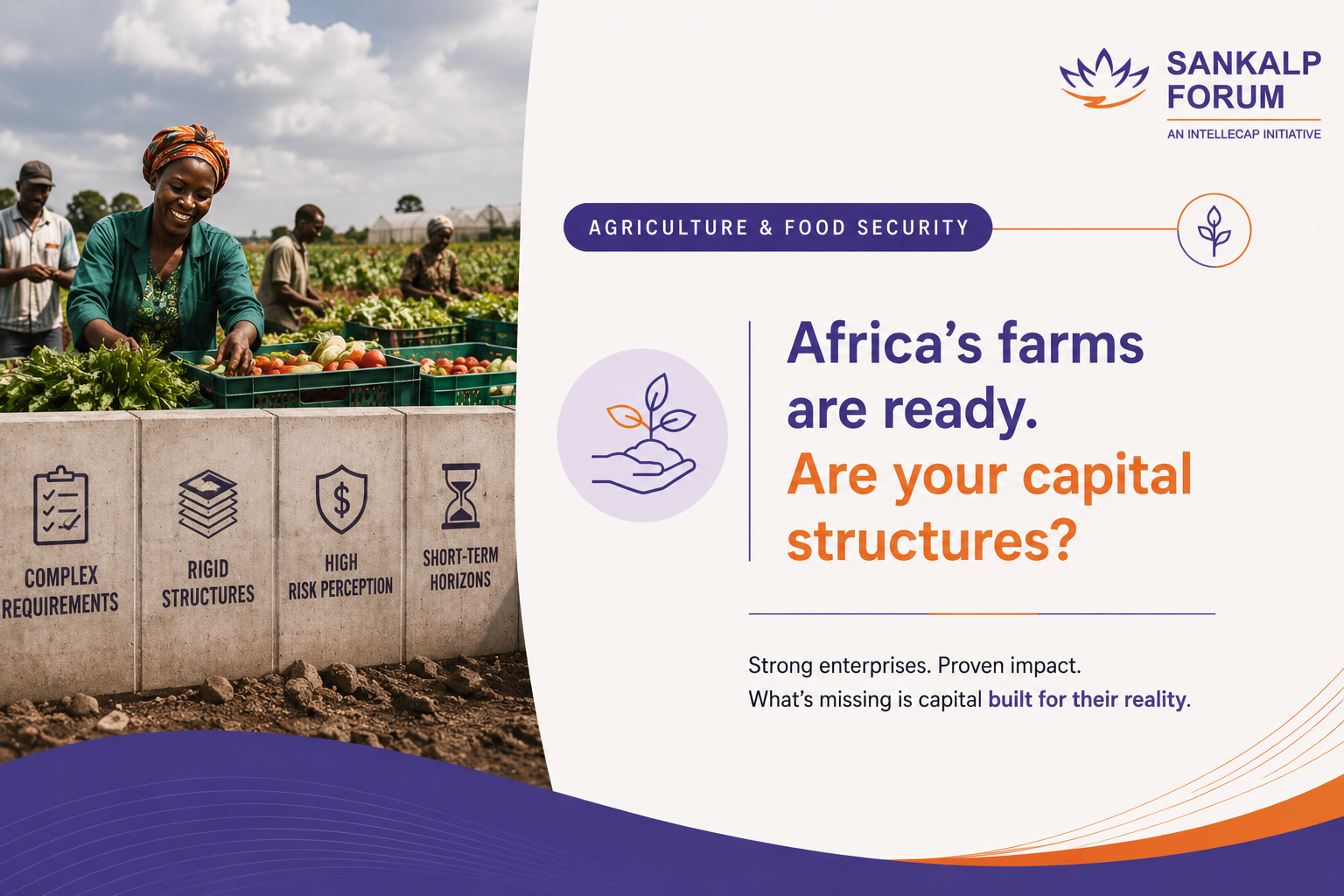
Africa’s food system enterprises are performing. Across staple grains, aquaculture, agroforestry commodities, high-nutrition legumes and dairy, founders are building real businesses, producing food, absorbing climate shocks, creating jobs. The pipeline is not the problem. What the agriculture sessions at Sankalp 2026 kept returning to was the distance between a performing enterprise and the capital it has earned, and what it would take to close it.
Banks are comfortable with commodities, not with complexity
There is a familiar story told about African agriculture: the deals are not there, the founders are not ready, the markets are too thin. That story is wrong, and the evidence has been piling up for years.
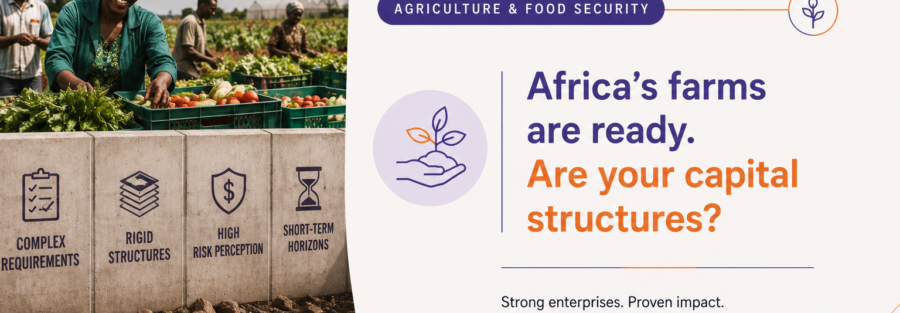
Across staple grains, aquaculture, agroforestry, high-nutrition legumes and dairy, founders are running real businesses: producing food, absorbing climate shocks, creating jobs. The capital, though, flows past them. Commercial banks across East Africa finance structured cash crops — tea, coffee, cocoa — where value chains are clear, offtake relationships are established, and collateral is familiar. They favour bankable clients with track records. The SMEs — potato farmers, mixed horticulture operations, nutrition-focused processors — are largely untouched, not because they are failing, but because the instruments to reach them do not exist.
Ask one of those banks to finance a cold-chain logistics operation for smallholder fisherfolk, or a processor working with iron-fortified legumes, and the answer changes. Not because the business is worse. Because the template does not fit.
These enterprises are not uninvestable. The instruments to serve them have simply not been built. That is a capital market failure, not a founder failure.
IDH’s Farmfit Fund is one of the few vehicles taking this seriously, deploying guarantees, subordinated loans, and equity into deals that commercial banks will not touch. IDH’s Grown Sustainably in Africa programme pairs affordable finance with technical support to bring African SMEs into global supply chains. TNO’s Flying Food consortium has spent four years building a cricket protein value chain across Kenya and Uganda. Eighty farmers are already operating. Demand exceeds supply. The plan is to expand to five more countries, creating 15,000 jobs, primarily for women and youth, while delivering 200,000 protein-rich servings annually.
The model works. The question is whether the financial architecture exists to take it to scale, or whether every expansion means starting from scratch.
African Farmers are living the Climate Crisis But the Capital is Still Preparing for it
Maize yields are falling. Rice fields are flooding. Bean crops are failing in heat that did not exist a decade ago. Farmers across East Africa are not anticipating climate change. They are managing it, right now, with whatever tools they have.
Between 2020 and 2022, the region experienced its worst drought in 40 years. Over 30 million people across Kenya, Ethiopia, and Somalia faced acute food insecurity. The shocks are becoming more frequent and more severe. Agribusiness supply chains that were built for predictable seasons are being stress-tested every year.
The frustrating part is that the solutions are known. Regenerative agriculture, solar-powered irrigation, climate-resilient seed varieties, digital advisory tools, carbon finance for soil recovery: all of these have been piloted and proven. The problem is not technical. It is financial.
Taking a climate solution from pilot to scale requires aggregation infrastructure, data systems, cooperative financing, and market linkages. That is a different kind of capital than what funds a proof of concept. Most of the capital sitting in development finance today was designed for the latter. The result is a landscape littered with successful pilots that never grew, and donors funding the same proof of concept in five different countries simultaneously.
When donor funding ends, the capacity it built disappears with it. That cycle is not a development problem. It is a capital design problem.
Blended finance works... but only when it is designed to absorb first risk
Launched in 2021 with a USD 5 million grant from the Rockefeller Foundation and implemented by Intellecap, the Good Food Innovation Fund ran for five years across Benin, Burundi, Ghana, Kenya, and Rwanda. Four cohorts. Twenty-four enterprises. The results were clear: an average 42% revenue increase per enterprise, improved production, new market partnerships, and a cohort of businesses that moved from early-stage to investment-ready.
What made it work was not the volume of capital. It was the design. The fund combined 80% repayable capital with 20% grant funding. Disbursements were milestone-based, not lump sum. Repayments revolved back into new enterprises. SMEs contributed a minimum 20% match, which built real ownership. Grants were not charity. They were tools that gave businesses room to test, build, and become bankable before approaching commercial finance.
The financing gap GFIF was built to address has not closed. Banks still favour structured commodity chains. The USD 5 to 10 million range remains almost entirely unserved: too large for microfinance, too small and too unfamiliar for conventional SME lenders. The enterprises with the greatest nutritional and climate impact sit exactly in that gap.
The fund took on first risk. That is what made it catalytic. Philanthropic and development capital has a specific job to do: absorb the risk that commercial capital will not touch, and prove the model so others can follow. Most of the time, it does not do that job.
The real frontier is Agro processing, not production
Coffee from Ethiopia roasted in Europe. Chocolate made in Belgium from Ghanaian cacao. The pattern is so familiar it barely registers as a problem anymore. Africa produces the raw material and earns the lowest margin in the chain, while roasting, processing, packaging, and branding happen elsewhere, along with the jobs and income they generate.
This is not inevitable. A partnership between a Kenyan coffee roaster and a Chinese producer introduced drip-bag coffee into Kenyan supply chains. Partnership for Forests’ venture studio built specifically around the processing and packaging step, not just production. IDH’s food systems work is premised on the same insight: the value is in the arc from farm to end market, and African enterprises can capture more of it if the investment is structured to go there.
Agro-processing is not a niche. It is where the margin lives, where the jobs are created, and where African food systems either develop resilience or remain permanently exposed to commodity price swings they cannot control. It is also where capital is most absent.
Refugee Settlements are Markets that have not been built
Regions like Turkana and Garissa are persistently characterised in investment conversations as fragile, high-risk, or unviable. However, these areas have large, concentrated populations, persistent supply deficits, and active entrepreneurship, from groundnut production in irrigation corridors to livestock and dairy systems that already involve both refugee and host communities.
The constraint is not demand, and it is not enterprise potential. It is the absence of market infrastructure: cold storage, energy for processing, input supply chains, aggregation, and offtake relationships that would allow existing demand and existing entrepreneurship to become an investment opportunity. Proven models already exist in these geographies. Kitchen garden programmes, pasture management schemes, and climate-smart horticulture pilots have all demonstrated viability. The policy environment is also shifting: Kenya’s SHIRIKA Plan and the Kalobeyei Integrated Socio-Economic Development Plan signal a government intent to treat refugee settlements as development zones, not only humanitarian response areas.
What first-risk capital actually looks like in practice
Intellecap has been working in African agriculture for over a decade, not as a funder of conversations about the sector, but inside it.
The Good Food Innovation Fund, run with the Rockefeller Foundation across five countries, generated USD 3.57 million in follow-on investment from under USD 4 million deployed. Twenty-four enterprises supported. Nearly 250,000 tonnes of nutritious food produced. The Water and Energy for Food programme across seven East African countries cut over 6,000 tonnes of carbon emissions annually, saved 16 million kilowatt hours, and reached nearly 100,000 smallholder farmers.
The South-South Agriculture Transfer Program connected Indian agri-tech enterprises with East African markets across parametric insurance, mobile soil testing, and solar cold chain. Thirteen thousand farmers now hold parametric insurance. The SSAGA alliance is a permanent mechanism, built to outlast any single funding cycle.
The architecture is consistent across all of it: patient capital alongside technical support, structured around what enterprises actually need, designed to survive the end of the grant.
The evidence is not the question. The question is who is willing to be first. First risk is not charity. It is the position that makes every subsequent investment possible.
The agriculture sector in Africa is not waiting for a breakthrough. It is waiting for someone to stop treating a capital market failure as a market failure.