

By Margaret Nakunza
Most countries electrify their roads from the top down. Government buys electric buses, subsidises electric cars, and waits for the technology to trickle to everyone else. Kenya did the opposite. The vehicles leading its transition are not buses or sedans but boda bodas — the motorcycle taxis that move people and parcels through every Kenyan town, ridden by the people who can least afford to waste a shilling.
The numbers tell the story plainly. At the end of 2021, fewer than 800 electric vehicles were registered in the country. By the end of 2025, that figure had crossed 43,000, of which more than 31,000 were motorcycles. In 2025, electric two-wheelers accounted for more than one in seven new motorcycle registrations. The shift went from curiosity to near-mainstream in four years, a pace that mirrors what Vietnam and China saw at the same stage.
Christopher Maara has been inside that curve since before it bent. He founded Kiri EV in 2020, when the entire country had a few hundred electric vehicles on its roads. He was early enough to be wrong about almost everything, and he was.
The Aha Moment Was Also a Correction
Maara came to electric mobility from energy: years in renewables, solar and pico-hydro installation work, before electric motorcycles caught his attention as the obvious next place for clean power to go. Kenya generates roughly 90% of its electricity from renewable sources, which makes an electric bike charged off the local grid genuinely clean in a way it would not be in a coal economy.
“At that time, I thought it would be an easy plug-and-play,” Maara says. “Just bring electric motorcycles from China and India and sell them, and rinse and repeat.” That assumption did not survive contact with the road. Imported bikes, designed for other markets, did not fit how Kenyan riders worked, charged, and earned. The product needed to be localised before it could work at all.
The real signal came with version 2, rebuilt around what riders had demanded. The entire batch was booked within a week of assembly. The demand for EVs was real but only for the right EV.
Why the Bottom of the Market Was the Right Place to Start
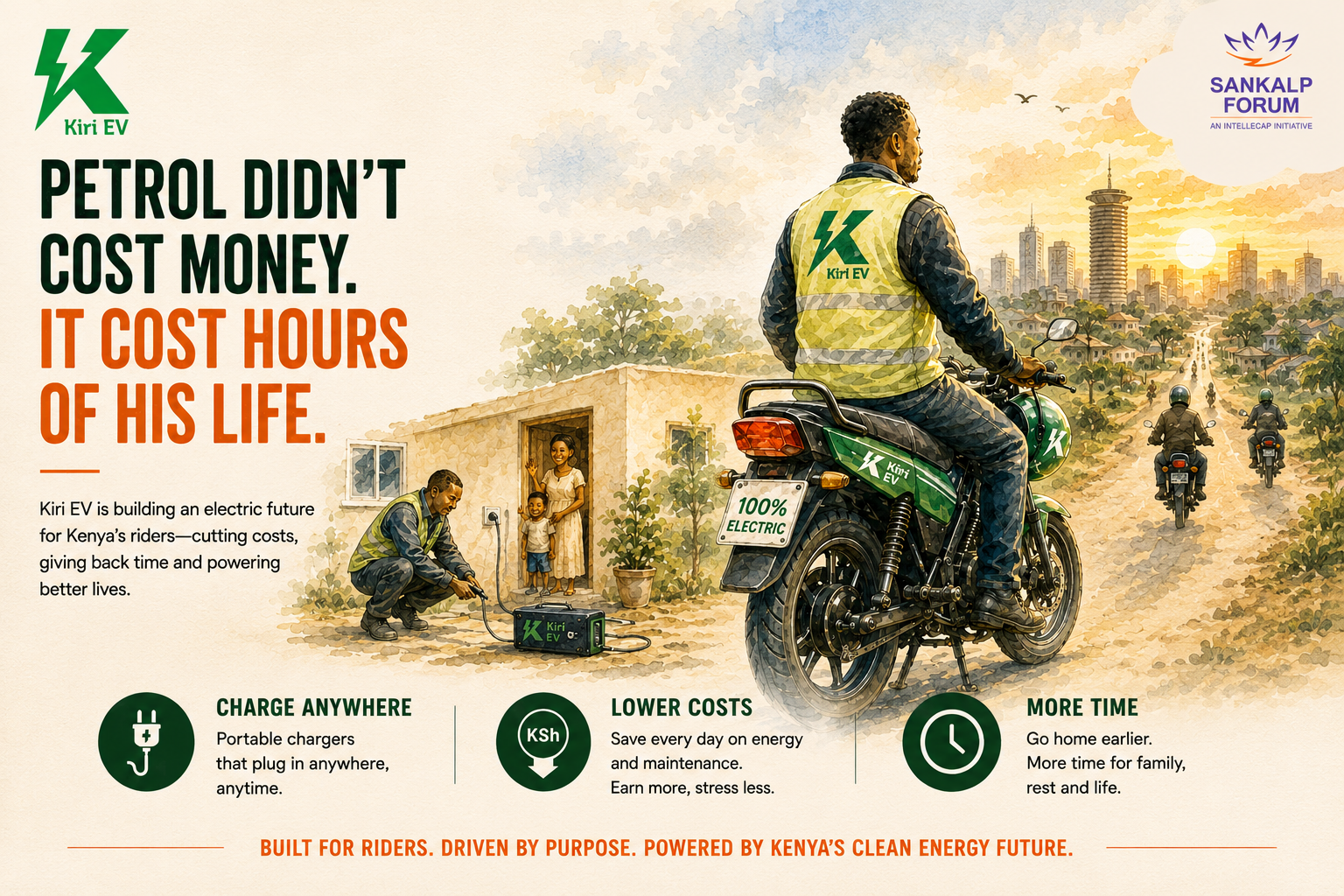
Maara made a deliberate choice to build for two-and-three-wheelers rather than chase cars. The reasoning is unsentimental: motorcycle taxi riders need fuel and maintenance savings more urgently than any other road user because those costs come directly out of daily take-home pay. A rider who used to spend more than 500 shillings a day on petrol can spend closer to 290 shillings charging, and maintenance costs fall sharply because an electric drivetrain has fewer moving parts to break. Kenya Power has watched its electric mobility charging revenue grow more than a hundredfold between mid-2023 and early 2026: an accounting echo of hundreds of thousands of riders quietly recalculating their economics.
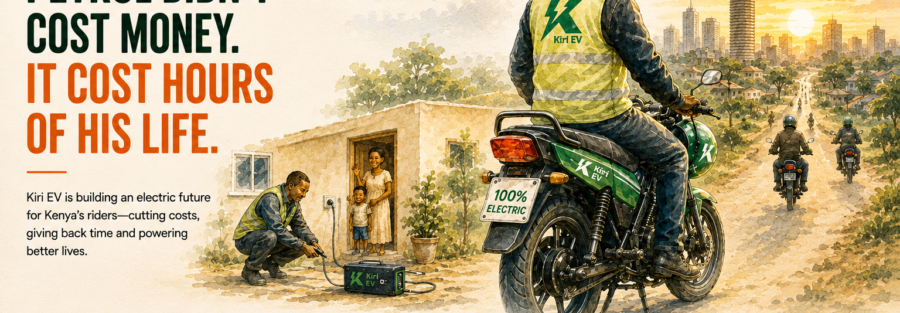
Maara returns often to one early customer: a rider in his fifties in Kisumu who has run a Kiri EV bike for over two years. The savings let him earn more while working less. He now closes his day around four in the afternoon, where the petrol economics once forced him to ride into the evening to make the same money. That is the impact Maara keeps coming back to. Not emissions avoided, but hours of a man’s life handed back to him.
The Ecosystem Is the Product
Kiri EV is often described as an electric motorcycle company. Maara describes it as something larger and more stubborn to build: an ecosystem. Smart batteries, tracking technology, charging infrastructure, spare parts, trained mechanics, financiers, and the regulatory plumbing around all of it.
The reasoning is about confidence, not features. A petrol motorcycle can be sourced from anywhere because the rider already knows fuel is available, mechanics know the engine, and the import structure is settled. None of that existed for EVs. Financiers needed tracking to monitor their investments. Riders needed to charge without fear of being stranded. Every party had to be made comfortable before the product could move.
Kiri gives every rider a portable charger — the way a phone comes with one — so they can charge from any socket without depending on infrastructure that does not yet exist everywhere. Kiri has also built its own proprietary charging network that any rider with that charger can plug into, rolling out through late 2026 into 2027. The bet is that affordable charging points deployable at many locations beat swap stations on both cost and reach. “It is always scary being the first,” Maara says. “But easier to follow the crowd as a customer.” He is engineering away the loneliness of being an early adopter.
The Competition Arrived, Which Means the Market Is Real
When Maara started, being early was lonely. It is no longer. Spiro has deployed more than 16,000 electric motorcycles across 22 Kenyan counties, backed by over 400 swap stations. Uber and Bolt have built large electric fleets in Nairobi. In mid-2026, Yadea — the world’s largest electric two-wheeler manufacturer — launched in Kenya with five models aimed squarely at boda boda riders. Asset financiers M-KOPA, Watu, and Mogo have poured pay-as-you-go credit into the segment.
This is the paradox of pioneering. The crowding that makes the market harder for Kiri is also proof that Maara read the opportunity correctly five years ago. The competitive question now is not whether electric motorcycles work in Kenya. It is who controls the ecosystem: the batteries, the charging, and the rider relationships that come after the first sale.
The Policy Whiplash Is Not Hypothetical
Of all the obstacles Maara names, policy instability is the one he returns to most pointedly and recent events prove the point: Kenya finalised its National Electric Mobility Policy in February 2026, promising incentives and a path to local manufacturing. Weeks later, the Finance Bill 2026 proposed moving electric motorcycles, buses, bicycles, and lithium-ion batteries from zero-rated to VAT-exempt status.
The distinction sounds technical, but it is anything but. Under zero-rating, an assembler charges no VAT to the customer and can reclaim the VAT paid on imported inputs, keeping build costs lean. Under exemption, that reclaim disappears, the cost gets trapped in the supply chain, and lands on the retail price. Assemblers estimate the change could raise the price of an electric motorcycle by tens of thousands of shillings — undoing the affordability that drove adoption in the first place. A government cannot announce an electric mobility policy and then tax away the economics that make it work. Maara has been making that argument for years. The country is now living the example.
What Kiri EV Is Actually Building
Africa’s EV direction is set. Ethiopia has banned new imports of petrol and diesel vehicles. Rwanda has restricted petrol motorcycle taxi registration. Kenya has pledged all new car sales will be electric by 2040. Maara’s framing is bigger than his own company — he believes Africa has a rare chance to skip a generation of combustion technology and stop being, in his words, a dumping ground for the world’s second-hand cars.
For Kiri, the strategy is to deepen the ecosystem, steadily increase locally manufactured parts, and remove every barrier to mass adoption — affordability, infrastructure, financing. The numbers that matter most are still ahead: a charging network that scales, a supply chain that localises, unit economics that separate a company that proved a point from one that builds an industry.
The riders have already done their own math. The policy is still catching up to them.
Christopher Maara is Founder and CEO of Kiri EV Limited, Nairobi. Kiri EV builds electric motorcycles, smart batteries, charging technology, and tracking systems for the Kenyan and East African markets. Kiri EV was one of the finalists for the Sankalp Africa Awards 2026.
*References: Africa E-Mobility Alliance registration data, 2025; Christian Science Monitor, Kenya electric vehicles report, May 2026; Techweez, Spiro and Finance Bill coverage, February and May 2026; TechTrendsKE, Yadea