
What India’s Soil Has Been Trying to Tell Us Since the Green Revolution — And How ScaNxt Is Responding With Data and AI
Green Revolution fed a nation. It also quietly poisoned the ground it stood on.
From the 1960s onward, state-subsidised urea and chemical pesticides transformed Indian agriculture — tripling production, averting famine, earning international acclaim. The bill, run up below the surface, went largely unpaid. Decades of monoculture and over-fertilisation have left nearly 60% of Indian agricultural soils suffering from degradation. A study of 50 million soil samples collected between 2015 and 2019 found that over two-thirds were deficient in key nutrients, and 85% contained too little organic carbon for a functional soil ecosystem. The Cancer Train in Punjab — carrying patients from the Malwa region to a cancer hospital in Rajasthan — has become the most visible symbol of what intensive chemical agriculture has done to the people living alongside it.
The government recognised the problem. In 2015, it launched the Soil Health Card scheme — a programme to test every agricultural plot and give farmers personalised soil reports. A decade later, 200 million cards have been issued. Most of the testing, however, remains on paper. The system behaves like a technocratic reporting tool — good for files, not for decisions. Dealers keep selling high-nitrogen inputs. Farmers keep applying them.
The infrastructure was built. The behaviour never followed.
Rajat Vardhan has spent his adult life watching that gap widen. He has spent the last several years building a device small enough to fit in a shirt pocket that might finally close it.
A Village Upbringing, a Corporate Education, a Decision
Vardhan did not arrive at agriculture through a market sizing deck. His father was a government doctor, and his childhood moved through villages and tier-3 towns across India. He studied agriculture at Govind Ballabh Pant University in Pantnagar, then spent years in senior agribusiness roles. The more time he spent with farmers, the harder a single contradiction was to ignore: the problems — degraded soil, pest damage, shrinking margins — were documented, understood, and largely unsolved. Not because solutions were impossible. Because the right tools had never been built at the right level, for the right user.
A visit to the United States in 2011 made the gap concrete. “Seeing the stark difference between Indian and global agricultural practices made me realise I had to do something meaningful about it in this lifetime,” he says. “Life is finite — why not dedicate it to a larger purpose?”
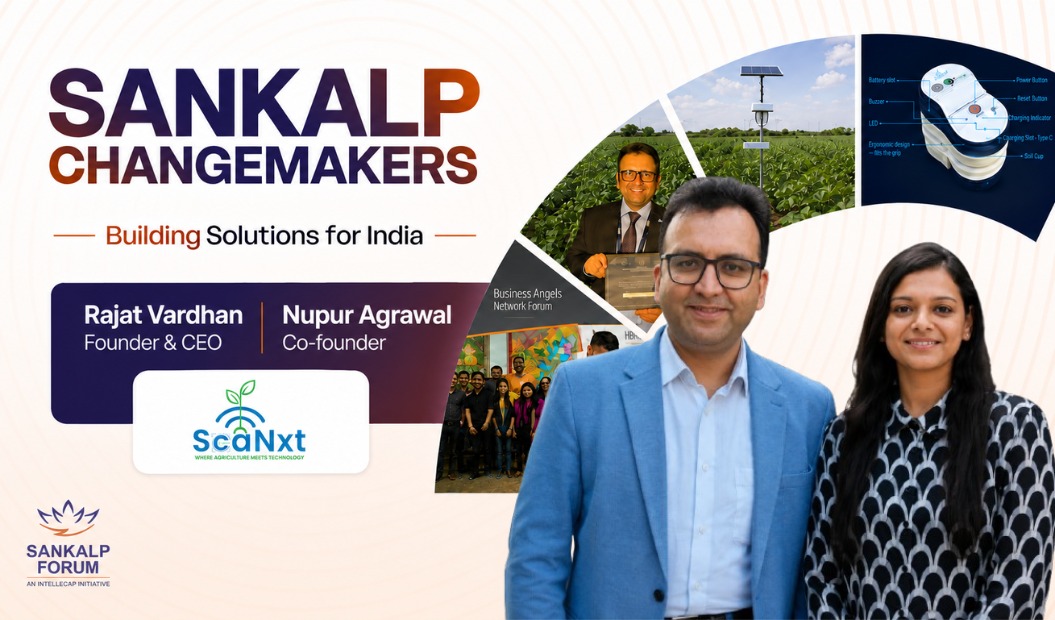
He eventually stepped out, with co-founder and spouse Nupur Agrawal, to build what had been missing. That company is ScaNxt.
The founding structure is worth a moment. Agrawal runs operations and finance — the load-bearing, less-celebrated architecture of a hardware deeptech company. Vardhan handles product, sales, and stakeholder relationships. People decisions are made jointly; domains are kept genuinely separate. In a company where supply chains are physical, cash cycles are long, and every product iteration is expensive, the person holding the operational engine is not support staff. Agrawal is co-architect of whatever ScaNxt becomes, and this piece would be incomplete without saying so plainly.
BhuParikshak: The Soil Examiner
BhuParikshak — literally, soil examiner — is roughly the size of a TV remote. Insert it into the ground, wait two to three minutes, and a report arrives on a mobile phone in the farmer’s own language: nutrient analysis, crop-specific recommendations, precise fertiliser dosage, calibrated to the local agro-climatic zone.
For a smallholder farmer with no buffer between a weak season and a catastrophic one, that report represents a category of information that has simply never been accessible at this speed, cost, or location. Poor soil health reduces crop yields by 20–25% in intensively farmed regions, and farmers spend 20–30% more on fertilisers when soil fertility has declined. Knowing what your soil actually needs — before spending money on inputs it cannot use — is not a marginal improvement. It is the difference between a season that works and one that doesn’t.
ScaNxt has also developed a patented Pest Detection and Monitoring System — granted in 18 months and 25 days from filing, an unusually fast timeline — that uses machine learning to calibrate interventions to economic threshold levels. The shift it enables is from calendar-based spraying to decision-based intervention. In a country where cancer incidence in Punjab’s Malwa region runs at nearly double the national average, largely attributed to pesticide exposure, that shift is not only an economic argument.
To maintain accuracy across India’s agricultural diversity, ScaNxt built a dedicated soil R&D division developing localised spectral models for different agro-climatic environments. BhuParikshak is already deployed across seven countries — Rwanda, Kenya, Tanzania, Zambia, Thailand, Mauritius, and Morocco. “Nobody told the soil what country it was in,” Vardhan says.
The Distribution Problem No App Has Solved
Building the device is one challenge. Getting it to a farmer in rural Hardoi is another.
India’s agritech sector has learned this lesson expensively. Agritech funding fell 30% in 2025 to $160 million, partly because investors have grown cautious watching well-funded platforms struggle to convert technology into behaviour change. DeHaat, AgroStar, CropIn, Fasal — each has digitised parts of the agricultural value chain. Portable, field-deployable soil diagnostics remains harder, requiring hardware precision, localised calibration, manufacturing depth, and farmer trust simultaneously.
ScaNxt’s answer is the Village Level Entrepreneur — a trained local operator serving 10 to 15 villages, deploying soil testing as a service while building a livelihood in the process. Trust in rural India travels through people farmers already know. The VLE is the human last mile. The three-year ambition: 10,000 VLEs serving 10 million farmers across India, Asia, and Africa.
The Question Scale Always Asks
In 2025, SIDBI’s SEED Equity Support gave ScaNxt ₹96 lakh through IIT Kanpur’s FUEL incubation programme. The company is also supported by FITT at IIT Delhi and iHub-AWaDH at IIT Ropar, was selected for the inaugural SSAGA cohort — the Intellecap-Gates Foundation South-South Agriculture Alliance — and presented at MIT Media Lab and Harvard Innovation Labs as part of the FITT IIT Delhi Boston delegation in early 2026.