
#SankalpChangemakers: Dr. Lorraine Muluka on the Pregnancy That Doesn't End at the Clinic Door
Malaica on why maternity care in Kenya needed to stop switching off between appointments
By Margaret Nakunza
A mother can leave a perfectly good antenatal appointment and still spend the next four weeks alone with her questions. No one to call when something feels off. No easy way to tell the difference between normal discomfort and a warning sign. That gap is what led Malaica’s founders to build a hybrid, midwife-led maternity care model in Nairobi, one that has since grown into outpatient and inpatient care, a multidisciplinary clinical team, and a network of peer communities for expecting mothers.
Malaica won the HealthTech category at the Sankalp Africa Awards 2026, recognised for improving access and outcomes for expectant mothers. We spoke to the team about the model, the economics behind it, and what scaling maternity care across Africa actually requires.
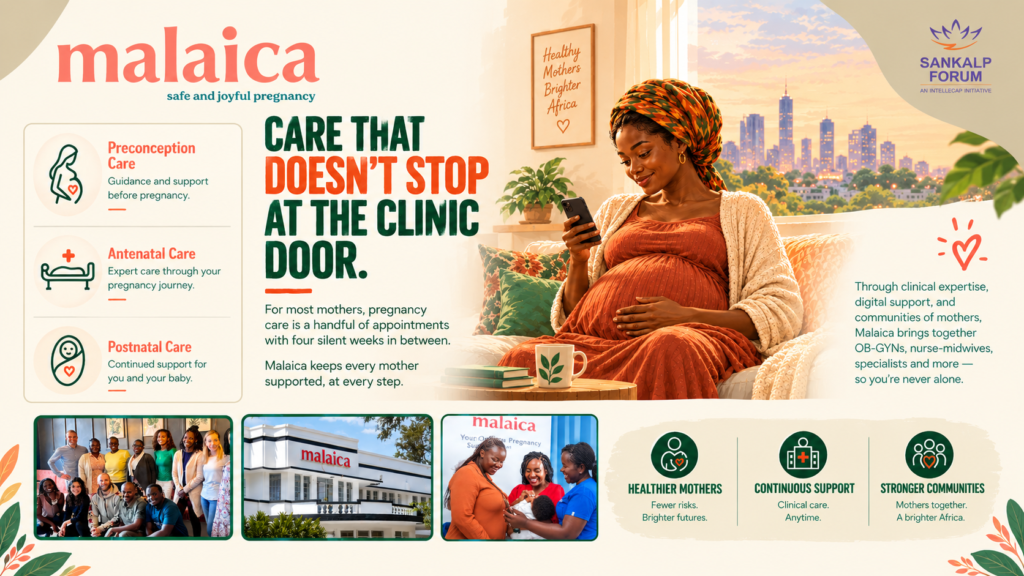
Malaica, at a glance Hybrid, midwife-led maternity care venture based in Nairobi, Kenya. Combines OB-GYNs, nurse-midwives, and a wider multidisciplinary team with digital support and peer communities of expecting mothers. Runs both outpatient and inpatient services from its own maternity hospital at 240 General Mathenge Gardens, Westlands. Winner, HealthTech category, Sankalp Africa Awards 2026.
Founding & Journey
What was the founding insight behind Malaica, was there a specific gap in antenatal or maternal care in Nairobi that made you believe a hybrid, midwife-led model was the answer?
The founding insight was that pregnancy care was too fragmented. A mother could have a perfectly good antenatal appointment and then spend the next four weeks largely on her own, with questions, anxiety, conflicting information and often no easy way to speak to someone who knew her pregnancy.
We also realised that pregnancy is not purely a medical journey. Mothers need clinical care, but they also need information, emotional support and community.
That led us initially to a hybrid model built around continuous access to a nurse-midwife and digital support between appointments. But the model has evolved substantially since then. Today, Malaica brings together OB-GYNs, nurse-midwives and a wider multidisciplinary team, together with digital support and a community of mothers going through pregnancy at the same time.
Your co-founder’s background is in digital health ventures like Ava, a fertility-focused startup. How did that experience shape the way Malaica approaches
It reinforced an important lesson: technology works best in healthcare when it strengthens the relationship between a patient and a healthcare professional rather than trying to replace it.
At Malaica, technology helps us maintain continuity,
The mother should ultimately feel that she has a team walking through the pregnancy with her, not that she is interacting with a piece of software.
Product & Care Model
Malaica pairs expecting mothers with dedicated midwives and blends this with hybrid, tech-enabled care. How do you design that experience so it feels personal rather than transactional, especially for first-time mothers?
We think about Malaica less as a series of appointments and more as a care relationship.
A first-time mother can have hundreds of questions between clinic visits, some clinical, some emotional and some as simple as wanting to know whether what she is experiencing is normal. We therefore surround her with several layers of support.
There is her clinical care team, including OB-GYNs and nurse-midwives, with access to other specialists such as psychologists, nutritionists
They can ask questions, compare experiences, encourage one another and eventually move into early motherhood together.
The communities are professionally supported, so mothers benefit from both peer support and trusted clinical guidance.
Technology helps us maintain all of those relationships at scale, but what the mother experiences should still feel very human.
What does ‘continuous’ pregnancy care mean in practice at Malaica, how do you keep a mother supported between clinic visits, not just during them?
Continuous care means that we do not believe maternity care should disappear in the weeks between appointments.
A Malaica mum has several layers of support around her. She has access to her clinical care team, so when something concerns her she can get professional guidance on whether it is normal, requires an appointment or needs urgent attention.
But continuity also comes from community. We group mums who are expecting to deliver around the same month, creating a peer community of women going through the same stages of pregnancy together. That means support does not only come from clinicians. Mums share experiences, reassure each other, learn together and form relationships that often continue into the newborn period. Our team supports those communities so mothers
We then combine that digital and community layer with comprehensive physical care.
Malaica now provides both outpatient and inpatient maternity services from our hospital at 240 General Mathenge Gardens in Westlands. Our multidisciplinary team includes OB-GYNs, nurse-midwives, nutritionists, psychologists, doulas and other professionals supporting the physical, nutritional and psychological aspects of pregnancy and early motherhood.
Mums can deliver at Malaica or, depending on their preference and care pathway, deliver with a Malaica OB-GYN at a partner hospital.
So when we say “continuous”, we mean continuity across time, setting and type of support, from the clinic to home, from medical questions to emotional wellbeing, from professional care to peer support, and from pregnancy through delivery and postpartum.
Business Model & Operations
Maternal health ventures often struggle to balance affordability with the cost of quality, expert-led care. How does Malaica’s model work financially to keep this accessible to a broad range of mothers in Kenya?
Our model is built around value-based care: better outcomes at a lower total cost of pregnancy. By combining prevention, continuous support, digital care and the right level of clinical intervention, we have shown that we can reduce pregnancy-related costs for insurers while improving the mother’s experience.
We already work with leading insurers and other payers, and as we scale, technology, higher clinical utilisation and stronger unit economics allow us to make high-quality care accessible while building a sustainable, profitable business.
What has been your biggest operational challenge in building a trusted, clinically credible service in a market where many mothers already have established routines with hospitals or traditional providers?
Trust has probably been the biggest challenge, and the most important thing for us to earn.
Malaica started as an online pregnancy-support programme, so we had to demonstrate that convenience and technology could coexist with serious clinical standards.
As we moved into outpatient clinical care and now into operating our own maternity hospital, that responsibility has become even greater.
We have therefore been deliberate about building a multidisciplinary clinical team and ensuring there is clear continuity between what happens digitally and what happens physically.
Another important part is giving mothers choice. A mother may receive her antenatal care through Malaica and deliver at Malaica, while another may prefer to deliver at a partner hospital with a Malaica OB-GYN. The objective is not to force every woman into one pathway, but to maintain continuity of care whichever pathway is right for her.
How do you measure impact at Malaica, is it clinical outcomes, mothers’ sense of safety and support, or something else entirely?
It has to be multidimensional.
Clinical outcomes are obviously critical: safe pregnancies, appropriate interventions, safe deliveries and healthy mothers and babies.
But we think maternal healthcare should also be judged by the experience of the woman receiving it. Did she feel heard? Did she understand what was happening? Could she reach somebody when she was worried? Did she have a voice in decisions about her care?
And there is a third dimension that is very important to Malaica: connection.
Pregnancy and early motherhood can be surprisingly isolating. Our communities bring women who are at similar stages together, so they quickly realise that many of the fears, questions and experiences they are having are shared by other mothers.
For us, a good outcome therefore means that a mother is clinically safe, informed, emotionally supported and not alone.
Market & Scale
Maternal mortality and access to quality antenatal care remain major challenges across Kenya and the wider region. How is Malaica positioning itself to scale beyond Nairobi and reach more underserved mothers?
What we have been building is not simply a hospital. It is a model of maternity care.
Physical facilities are an important part of that model, and opening Malaica’s own maternity hospital gives us the ability to provide a much broader continuum of care ourselves.
But the digital and community layers mean that the relationship with a Malaica mum is not restricted to when she is physically inside one of our facilities.
That becomes very important when we think about scale.
Over time, the same technology, clinical protocols, communities and care teams can work alongside different physical-care networks. Partnerships with hospitals, insurers, foundations and other organisations can then extend Malaica’s model into places where it would not make sense for us immediately to build our own hospital.
So we see the hospital as an important part of our growth, but not the limit of the model.
What does successful scale look like for Malaica in the next 3–5 years, in terms of mothers supported, midwives on the platform, or markets beyond Kenya?
Successful scale means building a large, profitable maternity-care company that delivers better outcomes at a lower overall cost.
We are targeting break-even in 2027 and around $10 million in annual revenue by the end of 2029, driven by more mothers, deeper insurer partnerships, higher utilisation of our clinical services, and technology that allows us to scale care efficiently.
Ultimately, success is proving that better maternal care and strong business economics can reinforce each other, and that Malaica can become a scalable model for maternity care across Africa.
Vision & Future
Looking ahead, what’s your bigger vision for Malaica and the future of maternal healthcare in Kenya and East Africa?
Our bigger vision is to change what a woman should reasonably expect from maternity care.
She should expect excellent medical care, certainly. But she should also expect to be listened to. She should expect access to help when she is worried. She should have support for her mental and emotional wellbeing. She should be able to access expertise in areas such as nutrition, psychology, childbirth and newborn care. And she should have a community of other mothers around her.
Malaica has evolved from an online pregnancy-support
Our ambition is to take everything we have learned from that journey and build a model that can serve millions of African mothers.
The future we are working towards is one where high-quality maternity care is continuous, multidisciplinary
[Editorial note: This profile is part of the #SankalpChangemakers series, spotlighting ventures recognised at the Sankalp Africa Awards for building solutions that expand access and improve outcomes across the region.]