

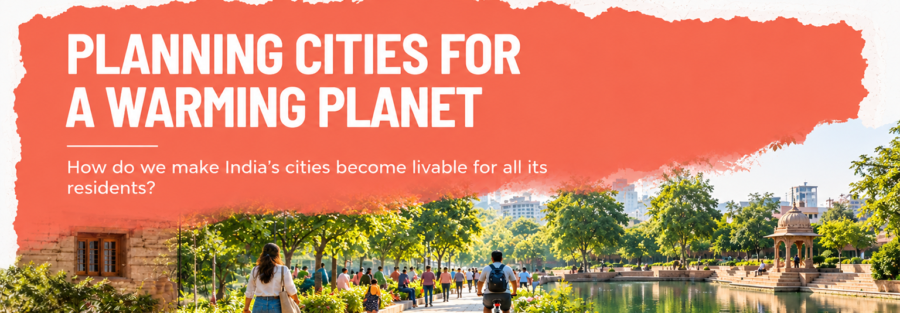
What would it take to make our cities liveable again?

  • Home
  • Blog
  • What would it take to make our cities liveable again?

What would it take to make our cities liveable again?

At United Nations General Assembly's review of the New Urban Agenda in July 2026, UN Secretary-General António Guterres made an observation that every global challenge eventually arrives at someone's front door
By Punita Maheshwari
 
In Pune, India temperatures reached 35.9°C on 10 October, making it the city’s hottest October day in 22 years. In Lucknow, September 27 saw 100 times the average normal rainfall, leading to flooding across the city. Climate change is knocking at our door, but it is not felt equally by everyone. 
 
Some of us can take shelter in air-conditioned rooms while construction workers labour through intense heat for minimum wage. For the homeless and communities living in kuccha houses, flooding can mean loss of life. This inequity is not restricted to severe events like heatwaves and floods alone. They percolate into everyday lives. Who gets to live in clean environments with 24/7 water access, proper sanitation? Who lives besides open drains, informal dump yards, and under asbestos roofs?
 
Urban policy may seem abstract, but it eventually becomes very personal. 

With rapid urbanization and unchecked development, our cities started losing touch with local culture, materials, and skills at the same time it adopted concretization as a thumb rule. The result? Multi-storied buildings built on cliff-edges on hills, an adoption of the plains model built with cement instead of rammed earth to trap heat in Leh. As Question of Cities wrote in a recent article, “Leh’s climate action plan, drafted within national frameworks, never once mentions rammed earth, vernacular construction, local materials, local mason, and engineering…”

Culture and climate, we find, are not too far apart. They are two sides of the same coin.  

Culture is reflected not only in how a city or its infrastructure looks from the outside, but how it is built, by whom, and for whom.
  
For example, do we need Italian marble when we have Red Oxide flooring to keep our floors cool in summer? The masons who excelled in the art of the famous Indian red flooring are no longer easy to find due to lack of demand. 
 
How do the poor, who build our cities and keep them functioning, live? What space to we offer farmers, artisans, and labour in the hustle-bustle of the city?  
 
What role can technology play to codify our cities to allow everyone to build from a culture-and climate-informed directory? And if technology is essential, who collects the data and in what form? 
 
At Sankalp Bharat 2026, these are the questions we seek to get answered in our session – ‘Climate-informed, culturally relevant: Building Livable Cities for all India’. The esteemed panelists will strive to arrive at actionable pathways to fundamentally change how we design our cities.  

At Shelter Associates, founded by architect Pratima Joshi, household surveys and geographic information systems have been used to map informal settlements and identify gaps in urban services to make them accessible to those living in slums. Pratima Joshi is called the architect of the slums. Her recently concluded work includes mapping Mohanlalganj, Banthra, and Ramsanehighat nagar panchayats near Lucknow to make the government’s urban and infrastructure planning responsive to community conditions.   

Jyotsna Kaur Habibullah, CEO of Lucknow Farmers Market, sowed the seeds of a community that brings together farmers, women entrepreneurs, artisans and consumers, over a decade ago. Today it has grown to over 5,000 farmers, artisans and founders with an online platform offering over 100,000 products pan-India. The community has become a mainstay of Lucknow city while providing livelihoods for them.  
 
Rajeev Lunkad, founder and creative director, DirectCreate approaches architecture from the integrated lens of design, craft, and technology. Its INDIA_SENSED project, developed with Rhode Island School of Design collaborators, brought students into Jaipur’s artisan environments to explore how craft is shaped by local climate, culture, materials, and infrastructure. Rajeev is building a Culture Stack for India’s cities. 
 
India has an opportunity to act before much of its future urban infrastructure is built. A 2025 World Bank report, Towards Resilient and Prosperous Cities in India, estimates that India’s urban population could rise from 480 million in 2020 to 951 million by 2050. With much of the infrastructure required for this growth yet to be built, cities have an opportunity to plan for resilience rather than retrofit after problems emerge.  
 
Attend Sankalp Bharat 2026 to discover ideas that can be adapted to your own city, learn what makes them work, and consider how we can build cities that are not only better planned, but also healthier, more inclusive and rooted in the lives and livelihoods of its people. 

Sources and Further Reading

LOVE

only 4
days left

Free shipping, delivered in time for Valentine’s Day.
Order now before it’s too late!