
What No One Tells You About Fundraising in Africa: Lessons from the Founder’s Table

  • Home
  • Blog
  • What No One Tells You About Fundraising in Africa: Lessons from the Founder’s Table

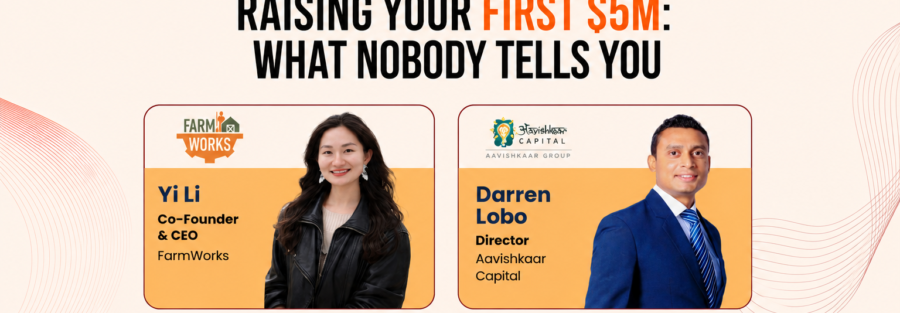
Last week, we hosted our Founder’s Table — a candid conversation between Yi Li, founder of Farmworks, and Darren Lobo, Director at Aavishkaar Capital. What emerged wasn’t a polished pitch masterclass. It was something more useful: hard-won, honest lessons about what fundraising actually looks like when you’re building in Kenya or across the African continent.

By Punita Maheshwari

Meet the Speakers

Yi Li, Co-Founder & CEO, Farmworks

Yi Li didn’t set out to become a farmer. She started her career at McKinsey & Company, bouncing between offices in the US, China, and eventually Kenya — the last stop being a somewhat accidental one after a US work visa didn’t come through. What could have been a setback turned into a pivot that changed everything. In late 2020, eager to move away from PowerPoints and into something she could build from the ground up, she was introduced to her co-founder Peter, who brought 30 years of farming experience to the table. Together they founded Farmworks — and Yi Li stepped onto a Kenyan farm for the very first time. 
 
Today, Farmworks supports over 4,000 smallholder farmers with market access, climate-resilient practices, and an obsessive eye on operational costs — down to the number of kilometres each truck travels per litre of fuel. Oh, and she also has a TED Talk. Not bad for someone who had never farmed a day in her life five years ago. 

Darren Lobo, Director – Credit, Aavishkaar Capital

Darren Lobo is the person in the room who will tell you exactly why your fundraising strategy won’t work — and then help you fix it. As Director at Aavishkaar Capital, he deploys capital through the Global Supply Chain Support Fund, backing large businesses that export out of Africa — from spice processors in Tanzania and Madagascar to manufacturers in Nigeria. Before finance found him, Darren’s background included sports coaching and team management — which, if you’ve ever watched him cut through a vague pitch in under two minutes, makes complete sense. He runs investment like a coach runs a team: clear on the mandate, zero tolerance for mismatched effort.  

Raise when the market lets you — not just when you need to

Yi Li made a point that stuck: Farmworks had an easier time raising in its early days not because the business was stronger, but because market liquidity was higher. When conditions shifted post-COVID, fundraising became significantly harder regardless of traction. 
 
Her advice? Always keep at least 20% of your time on fundraising — not just when you’re running low on runway. And when capital is available, take it thoughtfully. Burn less, extend your runway, and never assume the market stays friendly. 

Know your investor before you pitch them

One of Yi Li’s most practical habits: she opens investor meetings by asking them questions first. What’s your fund mandate? What sectors do you cover? What instrument do you deploy — equity, debt, convertible? What’s your investment timeline? 
This isn’t just courtesy. It’s strategy. Pitching an equity story to a debt fund, or asking for $1M from an investor whose maximum ticket is $100K, wastes everyone’s time and burns a relationship that might have been useful later. 
Darren echoed this from the investor side: the first conversation is almost entirely about mandate fit. Do your homework on an investor’s portfolio, ticket size, and sector focus before you walk in. 

Create urgency — legitimately

Investors will always ask when you want to close. Yi Li’s approach: give them a real answer, backed by a real reason. A board meeting, a co-investor deadline, an operational milestone. Manufactured urgency backfires. Legitimate urgency — communicated clearly — moves deals forward.

Investors in Africa are few. Exits are fewer. That changes everything.

Darren offered a sobering structural point: unlike in the US, China, or India — where a founder can hear “no” from ten investors and still find the eleventh — Africa’s investor base is thin. A few rejections can mean the market is closed to you. 
This has a direct implication for how you build: you cannot afford to burn capital chasing product-market fit across multiple pivots. You need to find what works with less, prove it early, and then raise to scale — not the other way around. 

Grants aren't free money

Yi Li was direct: she no longer pursues grants for Farmworks. Not because they’re bad, but because restricted grants come with reporting obligations and donor agendas that compete with a founder’s bandwidth. Unless you can access unrestricted funding, the hidden cost of grants — in time and focus — can outweigh the benefit.

Keep your investors in the journey, not just the highlights

Farmworks has seen follow-on investment from most of its early backers. Yi Li attributes this to one habit: consistent, honest communication. Not just wins — also mistakes, pivots, and what she’s learning. Investors who feel like they’re watching a founder grow are far more likely to double down than those who only hear from you when you need more money. 
 
Questions kept coming even after the session officially wrapped, with founders and investors continuing the dialogue long after the microphones were off. 

 
Eighty people showed up for honest answers about what fundraising in Africa actually looks like. They got them — and then some. 
The Founder’s Table is a space for real conversations between founders and entrepreneurs — the kind that don’t always happen in formal pitch rooms. Stay tuned for our next session. 
LOVE

only 4
days left

Free shipping, delivered in time for Valentine’s Day.
Order now before it’s too late!