


Insights from the inaugural Sankalp Dialogues webinar
By Ankit Gupta & Punita Maheshwari
Across India, Africa, and other emerging markets, many promising enterprises reach a familiar crossroads. They have proven technology, decent customer base, and demonstrated impact. Yet when it comes time to scale, capital becomes harder and not easier to access.
This is the “missing middle” – critical financing gap between $1 million and $5 million that exist between grants and commercial capital. They are too advanced for philanthropic funding, too early or risky for conventional lenders, and often too incremental for venture capital, leaving them underserved by financing options that were not built for their stage of growth.
The consequences extend far beyond individual enterprises. When enterprises cannot access the capital needed to scale, the result is slower job creation, delayed climate action, reduced innovation, and weaker economic resilience across emerging markets.
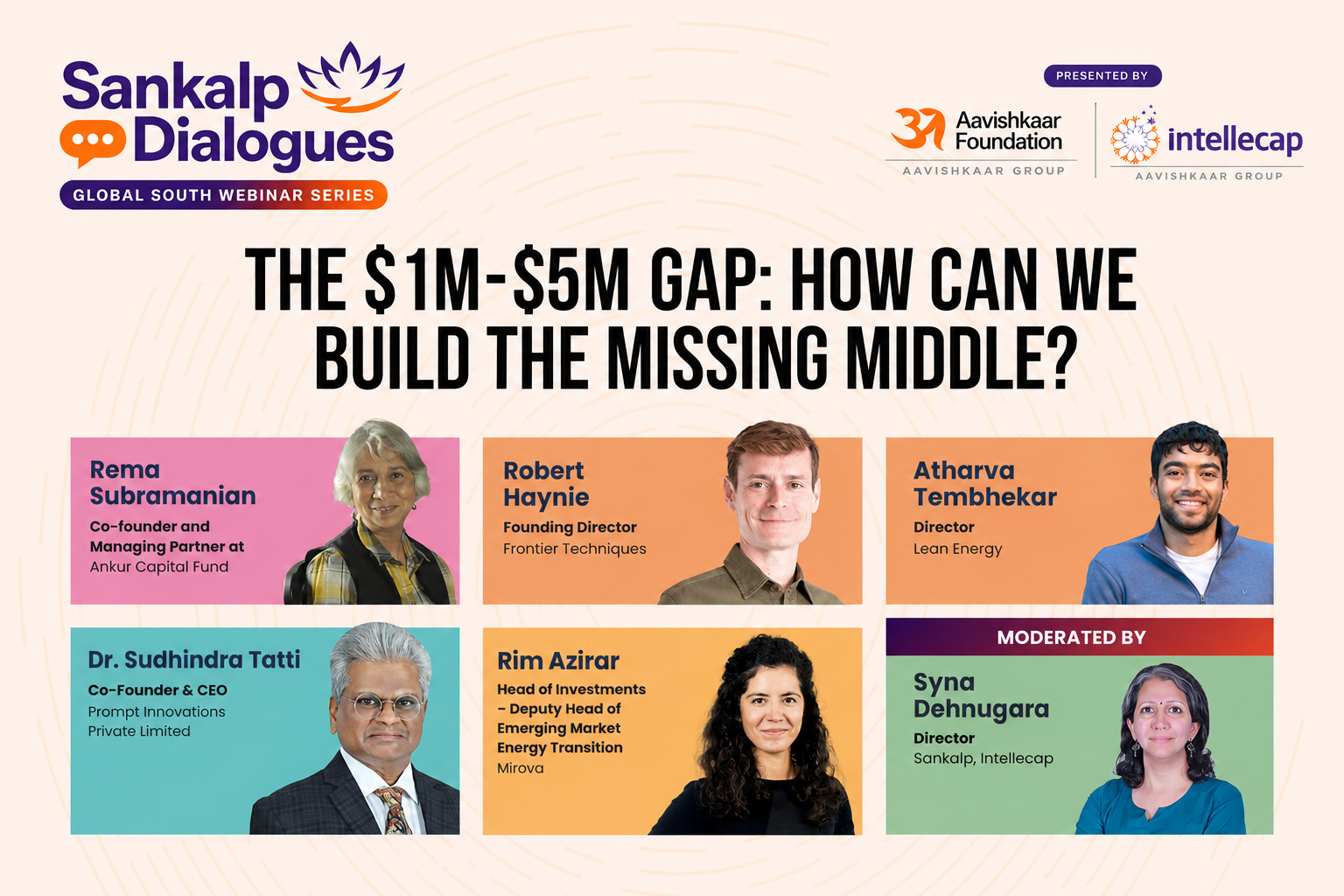
This challenge was the focus of the inaugural Sankalp Dialogues webinar, moderated by Syna Dehnugara, Global Lead at Sankalp Forum. Bringing together investors, entrepreneurs, development finance practitioners, and ecosystem builders, the discussion moved beyond a familiar question of why the missing middle persists to the more pressing challenge of how the ecosystem can collectively close it?
The discussion with Rema Subramanian (Ankur Capital), Robert Haynie (Frontier Techniques), Rim Azirar (Mirova), Dr. Sudhindra Tatti (Prompt Innovations), and Atharva Tembhekar (Lean Energy | B Corp Certified) pointed to one overarching conclusion: The missing middle is not primarily a capital shortage problem rather it is a capital architecture problem.
What is missing is the market architecture – appropriate financing structures, aligned incentives, and capable intermediaries that can connect capital to enterprises at the right stage, ticket size, and risk profile.
Key takeaway
- No single instrument can solve the missing middle. Growth-stage enterprises require a continuum of capital, from grants and catalytic funding to growth equity and debt, as they scale.
- Blended finance is needed to mobilize commercial capital for missing middle. Concessional, first-loss, and risk-sharing capital should be used strategically to de-risk investments and crowd in private investors.
- Domestic capital must play a larger role. Unlocking pension funds, insurance capital, family offices, and local financial institutions is critical for building sustainable financing ecosystems.
- Intermediaries play a catalytic role. Accelerators and ecosystem platforms are essential to connect enterprises with the right capital at the right stage.
The Challenge: Why businesses find it difficult to scale
One of the key insights from the discussion was that the missing middle is not a single problem but a combination of structural gaps.
Rema Subramanian, Co-founder and Managing Partner at Ankur Capital, highlighted three interconnected challenges at the heart of missing middle: enterprises are still navigating the path to commercialization, a limited pool of investors willing to fund the growth transition, and a mismatch between the returns many businesses can realistically deliver and those many investors expect. For entrepreneurs, this often create a classic catch-22: capital is needed to achieve scale, yet investors wait for evidence of scale before committing capital.
“Are there enough players willing to take the first part of the commercialization journey?”
— Rema Subramanian
Sudhindra Tatti, Founder of Promethean Technologies, also shared a familiar challenge. After years of product development, technology validation, demonstrations, and grant-supported pilots, his company reached at an inflexion point where it requires capital designed for growth and market expansion, which is not easily available.
“Many enterprises are not failing because the demand is absent. They’re failing because the financing architecture is simply not built to support every stage of growth.”— Atharva Tembhekar
Atharva Tembhekar, Founder of Lean Energy, echoed this challenge from a different vantage point. Having largely bootstrapped the business for several years, he noted that growth was constrained not by market demand but by the pace at which internal cash flows could be reinvested. His observation reflected a broader reality across emerging markets that enterprises are failing because the financing architecture is not built as per their demand.
Why existing capital is unable to meet the demand
If entrepreneurs struggle to access suitable capital, investors face a different but equally important challenge: the structures through which capital is raised and managed are often not designed to serve the missing middle.
Rim Azirad of Mirova (formerly SunFunder) highlighted a structural constraint that becomes more pronounced as funds grow. While larger funds can mobilize significant more capital overall, deploying it efficiently in $1–5 million ticket size is often difficult because transaction costs do not decline proportionately with ticket size. She mentioned that many investors may be willing to finance growth-stage enterprises, but the economics of doing so at scale can be challenging.
“The cost-to-ticket ratio is one of the true hindrances GPs face.”
— Rim Azirad
The challenge extends beyond debt providers. Venture capital faces its own structural limitations. As Rema mentioned, many impact-driven businesses operate in sectors such as climate, agriculture, manufacturing, and infrastructure, where growth trajectories are longer, capital requirements are higher, and returns may not align with traditional venture capital expectations. These businesses often require patient capital, yet much of the investment ecosystem remains geared toward faster-growth models.
The result is a persistent mismatch. Many of the enterprises most critical to job creation, climate action, and economic resilience find themselves caught between financing models with fundamentally different mandates, risk appetites, and return expectations.
How the ecosystem players are closing the gap
While there was broad agreement on the nature of the challenge, the discussion also revealed a growing consensus around what it will take to close the missing middle.
1. Reimagining risk through smarter capital structures
The first priority remains addressing the risk-return mismatch that often prevents capital from reaching growth-stage enterprises. Our speakers highlighted a range of tools including blended finance, guarantees, milestone-based financing, and results-based structures that can help absorb early-stage risk and unlock larger pools of commercial capital. Rim Azirad pointed to milestone-linked facilities that commit capital upfront but release it as enterprises achieve predefined targets, providing founders with greater visibility while reducing investor risk. Robert Haynie similarly emphasized the importance of liquidity mechanisms that enable investors to recycle capital more efficiently, making longer-horizon investments more attractive.
The broader lesson was clear: bridging the missing middle is not always about deploying more capital it is often about structuring capital more effectively.
2. Broadening the investor base
A second priority is expanding the pool of capital. To date, much of the financing for the missing middle has been driven by development finance institutions, catalytic investors, and public-sector initiatives. While these actors remain essential, our speakers agreed that long-term scale will require deeper participation from domestic capital markets.
Family offices, pension funds, insurance capital, high-net-worth individuals, and local financial institutions all represent significant untapped sources of patient capital. Robert highlighted emerging efforts to engage pension funds for impact investing, while Rema pointed to India’s fund-of-funds approach as an example of how catalytic public capital can help mobilize broader private-sector participation.
“If we solve the liquidity problem, we can bring more patient capital into the market.”
— Robert Haynie
Overall, closing the gap will require moving from niche impact capital to mainstream investment participation.
3. Strengthening the missing layer: Intermediation
Even where capital exists, many enterprises struggle to access it. Our speakers emphasized the critical role of intermediaries including accelerators, venture studios, fund managers, advisors, and ecosystem organizations in helping businesses become investment-ready and navigate increasingly complex financing pathways.
As Robert noted, enterprise support systems are most effective when they are closely linked to investment pathways, ensuring that founders receive not only technical guidance but also access to the financing solutions most relevant to their stage of growth.
Strong intermediation is, therefore, the connective tissue of the ecosystem, linking capital supply with enterprise demand and translating investment interest into investable opportunities.
Conclusion
The discussion did not converge on a single breakthrough solution. Instead, it underscored a broader reality: closing the missing middle will require a more connected, flexible, and collaborative financing ecosystem.
Significant challenges remain: patient capital is still in short supply, blended finance has yet to reach the required scale, domestic capital mobilisation is still evolving, and many innovative financing structures remain difficult to replicate across geographies and sectors. Yet there are reasons for optimism: new financing models are emerging, investors are becoming willing to experiment with risk-sharing structures, domestic capital pools are beginning to engage, and ecosystem actors are increasingly collaborating to address longstanding market gaps.
“The valley of death is not between invention and innovation – it is between validation and scale.”
— Sudhindra Tatti
The path forward is unlikely to be defined by a single instrument or institution. It will be built through the gradual alignment of capital, incentives, and intermediaries around the needs of growth-stage enterprises.
How Intellecap is supporting the missing middle:
● Mobilized catalytic grant capital from a leading foundation to support five high-potential agri-tech enterprises, enabling the piloting and scaling of innovative climate smart agriculture solutions that reached over 35,000 smallholder farmers in Africa.
● Managed UN-supported technical assistance facility supporting 10+ low-carbon technology enterprises, strengthening investment readiness and enabling catalytic capital mobilization, including for a deep-tech company that successfully secured funding from a leading public-private investment platform.
● Designed blended finance facility with a global intergovernmental organization to mobilize capital for energy enterprises in Africa. The facility combines payment guarantees, risk-sharing instruments, insurance mechanisms, and technical assistance to de-risk investments, bridge viability gaps, and attract private capital.