India has approximately 3,000 traditional art forms. Most people would struggle to name ten.
This is not a failure of interest. Collectors in London and Singapore have been paying serious money for Indian folk art for decades. It is a failure of infrastructure. The Pattachitra master in Raghurajpur and the collector in Kensington had no reliable way to find each other. The art existed. The demand existed. The gap between them was structural, not cultural — and it was waiting for someone with the right instincts to close it.
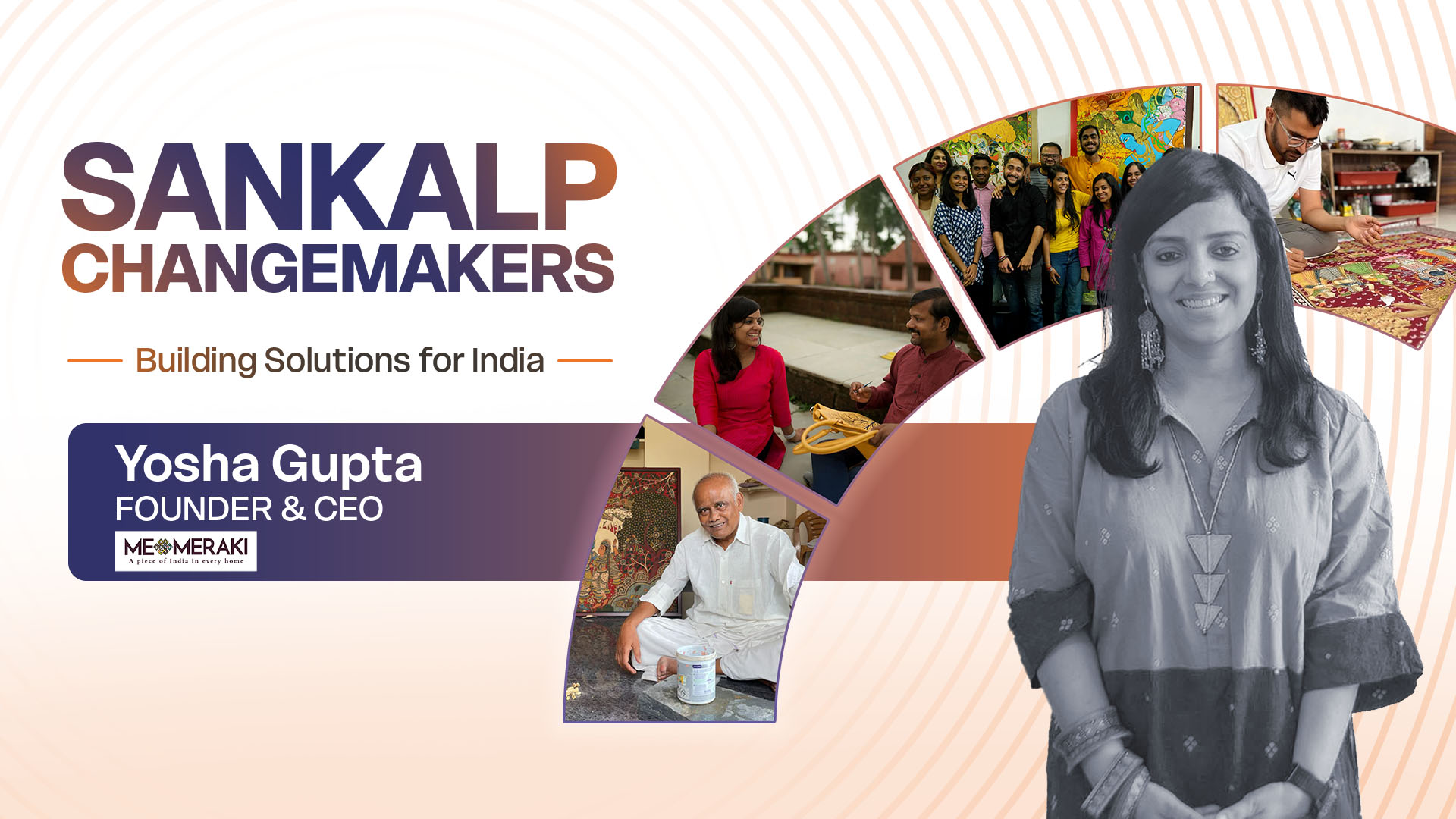
Yosha Gupta had spent fifteen years building exactly those kinds of bridges. At the World Bank Group, the Gates Foundation, and IDEO, working across India, Hong Kong, Indonesia, and the Philippines on financial inclusion, one belief had crystallised: access to income is the most powerful driver of inclusion. When she eventually turned to India’s heritage arts, the problem looked entirely familiar: extraordinary skill on one side, broken access to markets on the other, livelihoods hostage to seasonal exhibitions and fragile intermediaries. She had spent a career closing exactly these gaps. MeMeraki was the same logic in a new arena.
MeMeraki is a culture-tech platform and home to over 10,000 original handcrafted artworks, one of the largest collections of Indian arts and crafts available anywhere on the internet.
Across 300-plus art forms, Gond from Madhya Pradesh, Kalamkari from Andhra, Chau masks from Bengal, Lippan from Kutch, Sanjhi from Uttar Pradesh, MeMeraki sells to everyone from individual collectors to Google, Hyundai, Adobe, airport terminals, and government ministries. Art sales on the platform start at ₹10,000 and go up to ₹5.25 lakh.
Good Intentions Aplenty. Successes?
The terrain MeMeraki entered is well-meaning and largely unsuccessful. Understanding why makes the attempt more interesting.
Platforms that stayed true to the artisan have generally stayed small. Gaatha — founded in 2009 by National Institute of Design graduates — began as a documentation project and became a marketplace, running on a model where 75% of revenue goes directly to the artisan. It is principled and beloved by those who know it. It has never broken through commercially. Integrity and growth have proven stubbornly difficult to reconcile in this space. Jaypore, which built genuine equity as a curated craft marketplace, was acquired by Aditya Birla Fashion and Retail in 2019 and absorbed into an ethnic wear portfolio. It validated the demand and answered a harder question: what happens when a craft platform can’t sustain its own growth path? It becomes retail
Good Earth — the first Indian brand to retail at the Smithsonian National Museum of Asian Art — achieved something rare: genuine luxury positioning for Indian aesthetic tradition. But it did so by centering the designer’s vision, not that of the artisan. The artisan remains a supplier.
The closest international precedent for what MeMeraki is attempting
That Maison Château Rouge needed a Paris address to achieve this is itself the critique and the task for MeMeraki attempting it from Delhi, on Indian terms, with Indian masters named and centred tells us that they have their work cut out.
The Master Is the Brand
MeMeraki works across more than 300 art forms with generational artists who grew up inside their traditions and carry their grammar in their hands. Several hold the Shilpguru, the Government of India’s highest craftsperson honour — awarded to roughly ten masters a year, requiring twenty years of practice and demonstrated transmission of skill to the next generation. MeMeraki’s
The structural difference from every marketplace before it is that the artisan is the product, not the supplier. The masterclasses that MeMeraki run are the clearest expression of this: you are not buying a Pattachitra painting, you are learning its grammar from the master who inherited it. That is a different transaction entirely — different economics, different customer loyalty, a fundamentally different answer to what makes the business defensible as it grows. A 60-40 split between B2C and B2B revenue reflects this dual architecture, with large-format installations for GMR Hyderabad Airport, Google, the Ministry of Culture, and international clients providing the high-ticket, predictable income that consumer sales alone cannot guarantee.
The technology layer is doing serious work too. When the catalogue crossed 10,000 artworks in 2024, Shopify’s platform limit quietly broke all search and filtering. The two-person tech team rebuilt it from scratch: the platform now handles simultaneous filters across artform, region, colour, and prices. Augmented reality lets a buyer in London visualise a Kalamkari on their living room wall before ordering. These are not decorative features but mark the difference between a marketplace that converts globally and one that doesn’t.
The Prada Moment
In mid-2025, Prada walked seven looks down its Spring/Summer 2026 Milan runway in sandals unmistakably derived from the Kolhapuri chappal. Each pair was priced at ₹1.2 lakh. The Kolhapuri artisan who inspired them sells the same sandal for ₹500 to ₹1,000. No artisan was credited. A PIL was filed in the Bombay High Court.
The episode made something plain that the Indian craft world has long known without being able to say loudly: Indian traditional craft is already priced as luxury by the global market. Luxury houses have for decades sourced from Indian artisans while the work gets passed off as European. The demand for Indian craft at luxury price points is not a future aspiration. The question is simply who captures the value.
When a Mughal Miniature master on MeMeraki’s platform paints Kuch Kuch Hota Hai in 22-karat gold leaf on handmade paper and sells it to a collector in Singapore for ₹5 lakh — with the artisan receiving a fair share directly, no middleman — that is not a feature of the model. It is the entire model.
What the Numbers Show
MeMeraki has channelled over ₹7 crore in new income to artisans, with average income uplifts of 20 to 30 percent. Uttam and Sonali Chitrakar, Pattachitra
Annual revenue reached ₹3.87 crore in FY2025, with profitability reported in the current year — rare in a space historically dependent on grants or investor subsidy. Sankalp Forum recognised MeMeraki at the 2021 Global Awards in the Livelihoods category — early signal, when the model was still finding its shape post-pandemic, that it was worth backing. IIMA Ventures came in as a pre-seed investor, followed by angels including Phanindra Sama and Aprameya Radhakrishna, and most recently Next Bharat Ventures (Suzuki-backed impact fund) leading a seed round in January 2026. A four-Shark deal on Shark Tank India Season 5 followed.
The Question Scale Always Asks
Yosha Gupta has given herself a tough target: ₹100 crore in revenue in the next five years. This will demand significant enterprise scaling and deeper global consumer reach. But the more fundamental challenge is one the sector has never honestly solved: can you scale an artisan-centered model?
There is also the next-generation problem, which the craft world discusses too rarely: young artisans increasingly see craft as offering less status and social mobility than driving for a cab aggregator. The most gifted leave. Centuries of transmitted knowledge disappear into cities.
MeMeraki’s most powerful counterargument to that drift is not a campaign. It is Uttam and Sonali Chitrakar’s fivefold income. It is Sai Kiran’s commission at the Red Fort. It is a seventy-five-year-old
When Prime Minister Modi presented Gupta with the National Startup Award in January 2026, she said the recognition truly belonged to India’s master artisans: the original entrepreneurs of the country.
It is a precise description of what six years of deliberate, commercially rigorous work has been pointed at: building the bridge and letting the artists walk across it, on their own terms, at a price that reflects what they are actually worth.
Nobody has cleanly done that yet, at scale, from India. That is precisely why it matters and why Yosha is a #SankalpChangemaker.
Yosha Gupta is Founder and CEO of MeMeraki, New Delhi. MeMeraki received the Sankalp Global Impact Innovation Award for Livelihoods in 2021.